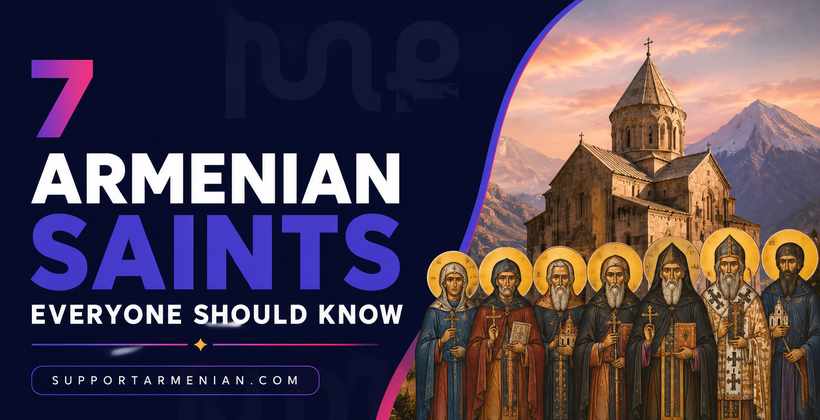
Armenia became the first nation in the world to adopt Christianity as its state religion — in 301 AD, a full twelve years before Rome's Edict of Milan. The Armenian Apostolic Church traces its origin to the apostles Thaddeus and Bartholomew, who brought the faith to Armenia in the first century. The men and women who carried that faith forward — through persecution, invention, and battle — became the saints whose names still echo in Armenian homes, schools, and churches today.
Some of them invented the alphabet. Some refused to bow to emperors. Some literally died for what they believed. Whether you grew up in the church or are just discovering Armenian Christianity, these are the seven Armenian saints worth knowing.
If Armenian Christianity has a founder, it's Gregory the Illuminator. Born into a Parthian noble family, raised Christian in Cappadocia, and eventually returning to Armenia to convert King Tiridates III, Gregory is the saint who turned a kingdom toward Christ.
According to tradition, Tiridates initially tried to force Gregory to renounce his faith. When he refused, the king had him thrown into a pit at Khor Virap for thirteen years. After Tiridates fell into a deep illness that no court healer could cure, his sister had a vision: only Gregory could save him. Gregory was pulled from the pit, healed the king, and baptized him. In 301 AD, the king declared Christianity the official religion of Armenia.
Gregory's feast is celebrated throughout the year in different commemorations, and the Mother See of Holy Etchmiadzin — Armenia's spiritual headquarters — was founded under his vision.
A monk, a scholar, a soldier, and ultimately a saint — Mesrop Mashtots is the man who gave Armenians their alphabet. After watching Armenian Christianity struggle to take root without a written language of its own, he set out to design one. In 405 AD, with the backing of Catholicos Sahak Partev and King Vramshapuh, Mashtots completed the 36 original letters of the Armenian alphabet.
The first sentence ever written in Armenian was from the Book of Proverbs: "To know wisdom and instruction; to perceive the words of understanding." Within a generation, the Bible had been translated into Armenian and a golden age of Armenian literature had begun.
Mashtots is buried in Oshakan, where pilgrims still bring their first-graders for an alphabet blessing on their first day of school — a 1,600-year-old tradition.
The other half of the alphabet story. Sahak Partev was the Catholicos of All Armenians and a direct descendant of Gregory the Illuminator. He partnered with Mashtots on the alphabet project, then led the translation of the Bible into Armenian — a translation so precise it earned the nickname "Queen of the Versions" from later European scholars.
Beyond translation, Sahak built schools, ordained clergy, and effectively founded Armenian literary culture as we know it. He's commemorated alongside Mashtots on the Feast of the Holy Translators, a uniquely Armenian holiday dedicated to writers, translators, and the act of putting words on a page.
Every Armenian schoolchild knows the name Vartan. The commander of the Armenian forces at the Battle of Avarayr in 451 AD, he led 66,000 Armenians against a Persian army of 200,000 sent to force the country to abandon Christianity for Zoroastrianism.
The Armenians lost the battle, and Vartan died on the field. But the resistance broke Persia's will: within 30 years, the empire formally recognized Armenia's right to practice Christianity. Vartan's famous line, recorded by the historian Yeghishe, still moves Armenians today: "Death not understood is death; death understood is immortality."
His feast day — Vartanants — falls in February and is treated as a national day of remembrance, taught in every Armenian school in the diaspora.
Before Gregory ever stepped foot in the royal court, Hripsime was already living — and dying — for her faith. A Roman noblewoman of stunning beauty, she fled Diocletian's marriage proposal and took refuge in Armenia with her abbess Gayane and a group of fellow nuns. When King Tiridates discovered her, he too tried to take her by force. She refused.
Tiridates had Hripsime and her companions martyred. Tradition holds that this act, and Tiridates's subsequent madness and healing by Gregory, was the catalyst that brought Christianity to Armenia. St. Hripsime Church in Etchmiadzin — built over her tomb in 618 AD — is one of the oldest surviving churches in the world and a UNESCO World Heritage Site.
Catholicos in the mid-4th century, Nerses I was a reformer in a country that needed one. He built hospitals, leper houses, orphanages, and the first organized network of charitable institutions in Armenia. He reformed the clergy, banned cruel customs, and pushed for ordinary Armenians to have access to schools.
His push for a stronger, less corrupt church angered the nobility — possibly fatally. According to tradition, he was poisoned at a royal banquet by enemies who wanted the old, looser ways back. Nerses is the saint Armenians invoke when thinking about justice, social welfare, and the church's role beyond Sunday liturgy.
Catholicos, poet, theologian, ecumenist, and one of the most quietly beloved figures in Armenian Christianity. Nerses Shnorhali — "Shnorhali" means "filled with grace" — wrote hymns and prayers still sung in Armenian churches today, including the haunting "Aravot Luso" ("Morning of Light"), traditionally sung at sunrise.
He pursued reunion talks with the Byzantine Church, wrote a 24-stanza poem of confession (one stanza for each hour of the day), and shaped Armenian liturgical music for centuries. If Vartan is the saint of resistance and Hripsime the saint of conviction, Shnorhali is the saint of grace — the soft, beautiful, patient kind.
Why These Saints Still Matter
You don't have to be religious to feel the weight of these seven names. Together they explain why Armenia survived as Armenia — a small mountain nation between empires, holding onto a language, a faith, and an identity through 1,700 years of pressure to give them up. Gregory and Tiridates made the country Christian. Mashtots and Sahak gave it a written voice. Vartan made survival possible. Nerses the Great built the institutions. Hripsime set the moral foundation. Shnorhali made it beautiful.
If you want to feel closer to that history, the easiest place to start is a name. Most Armenian families carry at least one of these saints into the present — through a son named Krikor, a daughter named Hripsime, a grandfather named Vartan. Each name is a thread back to a moment when the entire future of a people balanced on a single decision.
Learn More
- Visit the Armenian Churches in our directory to find a parish in your area.
- Read more about Armenian history and how faith shaped Armenian identity.
- Browse our Notable Armenians directory for more figures who shaped the nation.
- Discover Mesrop Mashtots and the Armenian alphabet in detail.
Sources
- Encyclopedia Britannica — Saint Gregory the Illuminator
- Encyclopedia Britannica — Mesrop Mashtots
- Encyclopedia Britannica — Battle of Avarayr (St. Vartan Mamikonian)
- Armenian Apostolic Church — Saints of the Armenian Church
- UNESCO — Cathedral and Churches of Echmiadzin (St. Hripsime)
- Encyclopedia Britannica — Nerses IV Shnorhali
- Encyclopedia Britannica — Saint Nerses I the Great
- Armenian History — Religious history and chronology
Discover more Armenian heritage
From the alphabet to the wedding ceremony — explore the traditions, food, and culture that make Armenian identity unique.