
In Armenian homes across the world, coffee is more than a beverage — it is a ritual, a moment of connection, and a window into the future. The Armenian word for coffee, soorj (սուրճ), carries centuries of tradition. Whether you're sitting in a living room in Los Angeles, Beirut, or Yerevan, the preparation and reading of coffee grounds is a cultural touchstone that has survived diaspora, war, and time itself.
This guide will walk you through everything: how to brew authentic Armenian coffee, the traditions surrounding it, and how to read the grounds for fortunes — a practice rooted in folk wisdom and deep cultural meaning.
The History of Armenian Coffee
Coffee arrived in the Armenian region in the 16th century through the Ottoman and Persian empires. While Armenia has its own ancient beverage traditions, coffee became deeply woven into Armenian social fabric — so much so that many outsiders assume it's native to the region. The Armenians adopted the coffee ritual but made it distinctly their own, distinguishing their method from Turkish coffee by emphasizing a slower, more meditative preparation and a slightly different brewing technique.
Soorj became inseparable from hospitality, family gatherings, and spiritual moments. To offer coffee to a guest is to offer welcome. To sit with coffee is to sit with time itself.
Soorj vs. Turkish vs. Greek Coffee: What's the Difference?
All three prepare coffee using similar methods — fine grounds in a small pot over low heat — but there are subtle, important differences. Turkish coffee is typically sweeter and uses a long-handled pot called a cezve or ibrik. Greek coffee is nearly identical to Turkish coffee but called by a different name (a legacy of political history). Armenian soorj emphasizes the ritual and the grounds, often skipping or minimizing sugar, and the preparation is slower and more deliberate, with greater attention to the sounds and smells as the coffee rises.
The difference between soorj and Turkish coffee is not in the beans but in the spirit — soorj is about presence, Turkish coffee is about tradition, and Greek coffee is about defiance. All are beautiful.
How to Brew Armenian Coffee (Soorj)
What You Need: A small long-handled pot (a jezzve, cezve, or Armenian coffee pot), very finely ground coffee, cold water, and a cup. The pot should be narrow at the top, wider at the bottom — this shape is crucial.
The Recipe (serves 1–2):
- Measure: Add 1 heaping teaspoon of very finely ground coffee to your pot. The grind matters more than people expect: it has to be a powder, finer than espresso, or the grounds will not settle into a pattern you can read. Surj is ground that way on purpose. If serving two, use 1.5–2 teaspoons. Add cold water — enough to fill the pot to about 3/4 full.
- Mix: Stir the coffee and water together thoroughly. This ensures the grounds are fully hydrated from the start.
- Heat slowly: Place the pot over low to medium-low heat. This is crucial — never rush soorj. The slower the better.
- Watch and listen: As the coffee heats, you'll begin to smell it. The grounds will slowly rise as heat builds. Listen for a gentle hiss. You're not looking for a boil.
- The first rise: When the coffee reaches the top of the pot and begins to foam, remove it from heat immediately. Stir gently, pushing the foam back down.
- The second rise: Return the pot to heat. Let it rise again — this second rise produces the finest crema and flavor. Remove from heat as soon as foam reaches the top.
- Pour: Slowly pour into your cup, allowing some of the grounds to settle at the bottom. Some traditions call for a third rise, but two is traditional in most Armenian homes.
Optional additions: Some families add a pinch of sugar, ground cardamom, or cinnamon during the mixing phase. In Armenian communities across the diaspora, tastes vary — some prefer it sweet, others prefer it pure. There is no wrong way.
Where to Get Real Surj
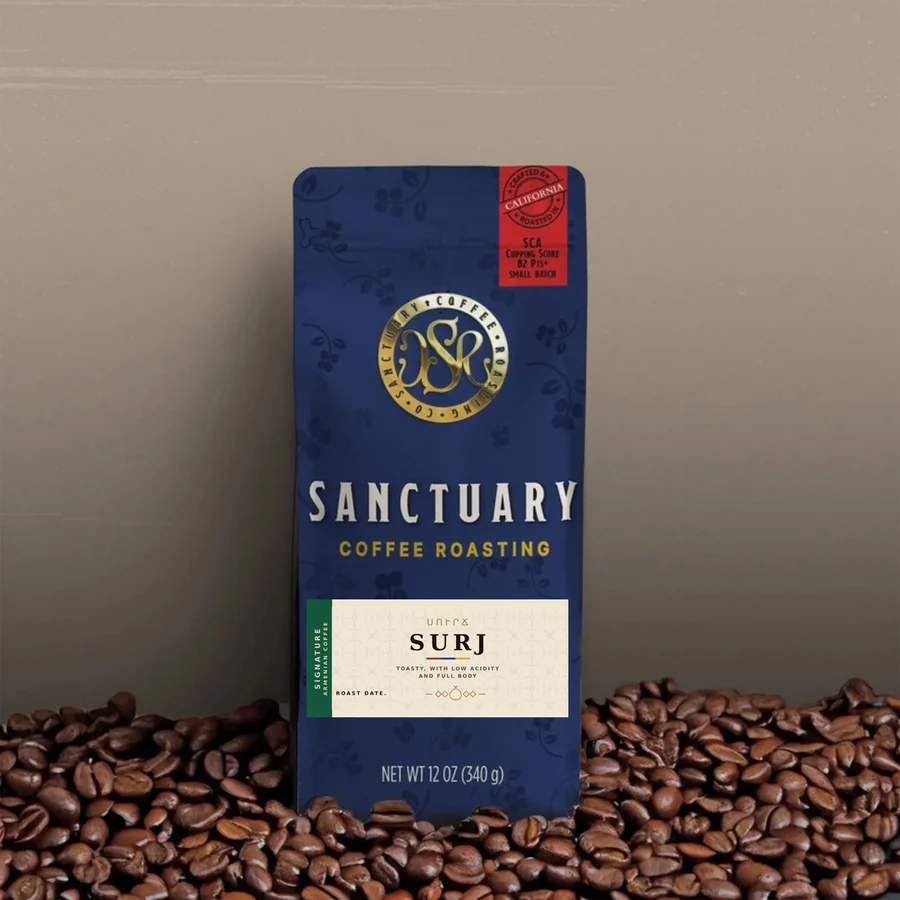
Armenian coffee roasted fresh in Clovis, California, pulverized extra fine for the jazzve, finer than espresso. 12 oz, $21, ships nationwide.
My aunt Lena read the cups in our family and she was the best at it. You need real grounds for that, which means you need real coffee. Almost all of the surj sold in this country was roasted overseas months before it reached the shelf. I roast every batch myself, weekly.
The Ritual of Coffee Reading: The Fal
After you've finished your soorj, the ritual continues. The grounds settle to the bottom of the cup, creating shapes and patterns that are then "read" — a practice called the fal (ֆա). This is where folklore, intuition, and spirituality meet.
The reader (usually an elder, a grandmother, a mother, or someone known to have the gift) will hold the cup, feel its warmth, observe the grounds, and look for symbols. While there is no standardized guide, certain shapes have traditional meanings passed down through families and communities.
Common Symbols in Coffee Reading
- Heart: Love, affection, or a romantic development. A gift of love is coming.
- Bird or wings: Travel, freedom, or good news arriving. Messages from far away.
- Fish: Abundance, fertility, wealth, or good fortune. A sign of prosperity.
- Road or path: A journey is coming — literal or metaphorical. A new direction in life.
- Letters or initials: The name of someone significant. Pay attention to who the letters spell.
- Ring: Marriage, commitment, or unity. Traditionally a very positive sign.
- Mountain or high place: Challenges ahead, but overcomable. Strength will be needed.
- Flowers or garden: Growth, beauty, new beginning. Spring is coming in some form.
- House or building: Stability, home, family matters. Something rooted and secure.
- Snake: Deception or danger. Pay attention to who you trust. Proceed with caution.
- Cross or X: Endings, obstacles, or something that needs to be crossed over. Not necessarily negative.
- Clouds or fog: Confusion, uncertainty, or obstacles that will clear. Temporary cloudiness.
How to Read Your Own Cup
While traditionally the reader is someone else, you can practice reading your own cup. Here's how: Let your coffee cool for a moment. Look at the grounds. Don't force interpretations — let shapes emerge naturally. Trust your intuition. What does a cluster of grounds remind you of? What do you feel looking at it? The symbols are less important than what they mean to you in this moment of your life.
The fal is not a prediction but a mirror — it reflects your subconscious concerns, hopes, and intuitions back to you. It's a tool for reflection, not fate.
Coffee in Armenian Family Life
In traditional Armenian homes, offering soorj is an expression of love and respect. When a guest arrives, coffee is prepared. When family gathers, coffee is made. It is offered to mark milestones — engagements, births, homecomings. An Armenian woman's skill with soorj — knowing exactly when to remove it from heat, how to achieve the perfect foam, how to serve it with grace — is a point of pride and a way of saying "you matter to me."
The ritual of coffee has also become a way diaspora communities maintain connection to homeland and heritage. In a Los Angeles kitchen or a Paris apartment, the sound of the jezzve heating up is the sound of Armenia — timeless and grounding.
Making Soorj Part of Your Tradition
To brew soorj is to slow down. In a world of instant coffee and quick fixes, soorj demands presence. It asks you to listen, to smell, to wait. Whether you believe in the fal or not, the practice of brewing and sharing soorj connects you to generations of Armenians who did the same. It's a small rebellion against rushing, a daily affirmation that some things are worth taking time for.
Sources
- Fragner, B. G. "From the Table to the Tomb: Food Culture and the Culinary Traditions of the Islamic Middle East." Columbia University Press, 2014.
- Ousterhout, R. G. "Eastern Medieval Architecture: The Building Traditions of Byzantium and the Lands of the Silk Road." Oxford University Press, 2019.
- Armenian Apostolic Church archives on food rituals and traditions.
- Oral histories collected from Armenian diaspora communities, 2020–2026.