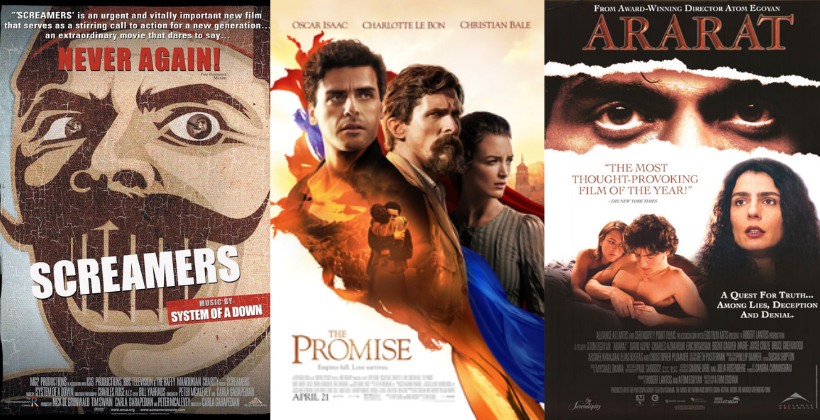
Film is one of the most powerful tools for bearing witness to history. For over a century, Armenian artists, journalists, and filmmakers — along with international directors — have worked to document, dramatize, and preserve the story of the Armenian Genocide of 1915–1923. Whether you're looking for a Hollywood drama, a harrowing documentary, or a quietly devastating art film, this list has something essential for every viewer.
These films are especially meaningful to watch in the weeks around April 24 — Armenian Genocide Remembrance Day — but they belong in every history-conscious household year-round.
Feature Films
From silent-era survivor accounts to modern Hollywood epics, these feature films bring the human experience of the Armenian Genocide — and its aftermath — to the screen.
The Promise (2016)
The Promise is the most ambitious Hollywood film ever made about the Armenian Genocide, with a reported $100 million budget funded in part by Kirk Kerkorian, the Armenian-American billionaire. Set during the final years of the Ottoman Empire, it follows a love triangle between a medical student (Oscar Isaac), an Armenian-American journalist (Christian Bale), and a woman from the Armenian diaspora (Charlotte Le Bon), as the genocide unfolds around them. Directed by Terry George (Hotel Rwanda), the film is a sweeping historical epic that brings the scale of the tragedy to mainstream audiences. Despite facing a coordinated campaign of negative online reviews from genocide-denial trolls, it remains one of the most important films about the genocide ever produced.
Ararat (2002)
Armenian-Canadian director Atom Egoyan's Ararat is a deeply layered, postmodern examination of memory, denial, and identity. The film uses a film-within-a-film structure: a movie is being made about the Armenian Genocide — specifically the 1915 Siege of Van — and the characters in the "real" story are all grappling with their own fractured relationships to Armenian history. Charles Aznavour, the legendary French-Armenian singer, appears as the director of the fictional genocide film. Rather than a straightforward historical drama, Ararat is a meditation on how communities reconstruct and transmit traumatic histories across generations. It is one of the most intellectually rich films ever made about the genocide and a uniquely Armenian cinematic voice.
The Cut (Der Schnitt) (2014)
German-Turkish director Fatih Akin — a significant figure given Germany's historical alliance with the Ottoman Empire during WWI — made The Cut as a deeply personal statement on genocide recognition. The film follows Nazaret Manoogian, an Armenian blacksmith in 1915 who survives a massacre but is rendered mute by a cut to his throat. He spends the next decade traversing three continents — from the Middle East to Cuba to Minnesota — in search of his twin daughters, whom he believes survived. Starring French-Algerian actor Tahar Rahim, The Cut is an epic odyssey that frames the Armenian story within the broader 20th-century immigrant experience. The film was controversial in Turkey upon release, where Akin received death threats, but he stood firmly by the work.
Mayrig (1991)
Mayrig — meaning "mother" in Armenian — is a French film directed by Henri Verneuil (born Achod Malakian), himself the son of Armenian genocide survivors. Based on his autobiography, the film follows the Zakarian family as they flee the genocide and settle in Marseille, France, navigating poverty, prejudice, and the long process of making a life in a new country. Claudia Cardinale plays the mother, Araxi, and Omar Sharif plays the father. It is one of the most personal and emotionally resonant films about the Armenian diaspora experience ever made — less about the violence of the genocide itself and more about its long shadow over family, identity, and the immigrant condition. A sequel, 588 Rue Paradis (1992), continues the family's story.
1915 (2015)
Released on the centennial of the genocide, 1915 is a bold, unconventional film by Armenian-American filmmakers Garin Hovannisian (son of historian Richard Hovannisian) and Alec Mouhibian. It features a playwright who is staging a play about the Armenian Genocide inside a theater, while outside, the modern political battles over recognition play out. Part theatrical drama, part meditation on memory and justice, the film features a standout performance from Simon Abkarian. It premiered at the Los Angeles Film Festival and represents a new generation of Armenian-American voices wrestling with inherited trauma and political responsibility.
Ravished Armenia / Auction of Souls (1919)
One of the earliest films ever made about the Armenian Genocide, Ravished Armenia (also known as Auction of Souls) is a silent-era Hollywood film based on the memoir of Aurora Mardiganian, a 14-year-old survivor who fled the massacres and deportations and eventually made her way to the United States. Mardiganian herself starred in the film, recreating scenes from her own survival. The film was a sensation when released — a major propaganda and awareness tool that brought the genocide to American audiences at a time when Near East Relief was actively fundraising to help survivors. Most of the original film has been lost; only a partial restoration of approximately 20 minutes survives, held by the Armenian Film Foundation in Los Angeles. It remains a haunting artifact of the earliest efforts to bear witness.
Documentaries
These documentaries range from rigorous historical investigations to deeply personal portraits of survivor families. Each is essential for understanding not just what happened in 1915, but how the genocide has shaped a people, a diaspora, and a century of international politics.
Screamers (2006) — System of a Down
Screamers is one of the most widely seen and emotionally powerful Armenian Genocide documentaries ever made — and it is free to watch in full on YouTube. Directed by British-Armenian filmmaker Carla Garapedian and premiering at the Sundance Film Festival, the documentary follows world-famous rock band System of a Down — whose four members are all of Armenian descent — as they tour North America and use their enormous platform to campaign for U.S. recognition of the Armenian Genocide. Serj Tankian, Daron Malakian, Shavo Odadjian, and John Dolmayan are the children and grandchildren of survivors, and the film interweaves the band's concerts and advocacy work with devastating archival footage, survivor testimony, and analysis from genocide scholars.
What makes Screamers especially powerful is its reach: System of a Down brought the Armenian Genocide to millions of rock and metal fans worldwide who might never have encountered the history otherwise. The film also examines the broader pattern of genocide — from the Armenian Genocide to the Holocaust to Rwanda — and asks why humanity keeps failing to prevent atrocities it has vowed to never repeat. Its title references the screaming voices of the dead that too few people choose to hear. The film is named in part after the band's own music and ethos of speaking truth against power. Search "Screamers System of a Down documentary" on YouTube or use the link above to watch it free.
Aghet — A Genocide (2010)
Aghet — meaning "catastrophe" in Armenian — is widely considered one of the most powerful documentary films ever made about the genocide. Directed by German journalist Eric Friedler for ARD, German public television, it takes a unique approach: actors read verbatim accounts from German and American diplomatic archives, eyewitness testimonies, and official communications that prove beyond any doubt that the genocide was premeditated, systematic, and observed in real time by Western governments who chose not to intervene. The fact that it is produced in Germany — whose government was allied with the Ottoman Empire during WWI and whose officers witnessed the deportations firsthand — gives it particular moral weight. The film was seen by millions in Germany and played a key role in building momentum toward the German Bundestag's recognition of the genocide in 2016. It is free to view on YouTube and essential viewing.
Intent to Destroy (2017)
Documentary filmmaker Joe Berlinger embedded with the production of The Promise (2016) and the result is a film as much about the act of making genocide films as about the genocide itself. Intent to Destroy captures the behind-the-scenes process of bringing the genocide to Hollywood while simultaneously interviewing historians, genocide scholars, survivors' descendants, and Turkish government officials who deny the genocide ever happened. The film also documents Turkey's sophisticated, well-funded lobbying campaign in Washington D.C. and Hollywood to suppress genocide recognition — making the title a reference both to the original genocide and to modern efforts to destroy the historical record. It is one of the most eye-opening films about how genocide denial operates as a political and cultural system, not just an isolated act of ignorance.
Armenian Genocide (2006) — PBS
Narrated by Julianna Margulies and produced for PBS, this documentary provides one of the clearest, most accessible overviews of the Armenian Genocide available in English. It covers the historical context of the Ottoman Empire's collapse, the rise of the Young Turks and the Committee of Union and Progress (CUP), the mechanics of the deportations and massacres, survivor testimonies, and the political aftermath including the United States' long refusal to formally recognize the genocide. It is an excellent starting point for viewers who are new to the subject and is widely used in high school and college courses as an educational resource. The documentary notably also addresses the response — and non-response — of the international community in 1915, drawing direct parallels to later genocides including the Holocaust.
Architects of Denial (2017)
Narrated by George Clooney and Cher (who is of Armenian descent on her mother's side), Architects of Denial focuses specifically on Turkey's decades-long campaign to prevent the United States government from formally recognizing the Armenian Genocide. The documentary exposes how Turkey used its strategic NATO membership, military partnerships, and lobbying dollars to suppress recognition efforts in Congress for more than 30 years. It features interviews with U.S. senators, genocide scholars, Armenian-American community leaders, and Turkish officials, and documents the specific mechanisms — embassy pressure, economic threats, diplomatic retaliation — used to keep genocide recognition off the table. The film was released two years before the U.S. Congress finally passed a joint resolution of recognition in 2019, and is a deeply unsettling portrait of how politics and money can suppress historical truth at the highest levels of government.
Operation Nemesis (2022)
In the aftermath of the Armenian Genocide, Armenian Revolutionary Federation operatives launched a covert assassination program called Operation Nemesis to track down and execute the masterminds of the genocide — the Young Turk leaders who had fled Turkey after WWI. The operation's most famous act was the 1921 assassination of Talaat Pasha in Berlin by Soghomon Tehlirian, a genocide survivor who had personally witnessed the murder of his family. Tehlirian's trial in Berlin became a landmark moment in the history of international law — he was acquitted, and the case directly influenced Raphael Lemkin's efforts to define and codify the crime of genocide decades later. This documentary tells that extraordinary story, connecting the quest for justice in 1921 to the foundations of modern international human rights law.
Literature That Inspired Film
Many of the most important films about the Armenian Genocide are rooted in literature. The Forty Days of Musa Dagh by Franz Werfel (1933) — a novel about the Armenian resistance at Musa Dagh — was one of the most celebrated books of the 20th century and inspired decades of Armenian cultural production. Hollywood attempted to adapt it in the 1930s, but the Turkish government successfully pressured the U.S. State Department to block production — itself a remarkable act of historical censorship. The novel remains essential reading.
My Name Is Aram by William Saroyan (1940), The Sandcastle Girls by Chris Bohjalian (2012), and The Bastard of Istanbul by Elif Shafak (2006 — banned in Turkey upon publication) are among the most widely read works of fiction grappling with the genocide and its long diaspora shadow.
"The more I researched the story, the more I realized this was not just an Armenian story — this was a human story about what we do to each other."
— Terry George, director of The Promise (2016)
Why These Films Matter
The Armenian Genocide is sometimes called the "forgotten genocide" — not because it is unknown, but because it has been systematically denied, suppressed, and kept out of mainstream historical consciousness by a sustained political and diplomatic campaign. Film has been one of the most powerful tools in pushing back against that erasure.
Cinema creates empathy where statistics cannot. Watching Aurora Mardiganian play herself in a 1919 silent film, or following Oscar Isaac through the burning villages of eastern Anatolia, or listening to German diplomats' own words read back as evidence in Aghet — these experiences lodge in the mind in ways that policy papers and Wikipedia articles do not.
Music has played that same role. System of a Down — one of the most successful rock bands of the 2000s — are all of Armenian descent, and their advocacy for genocide recognition reached audiences that no documentary could have reached on its own. Screamers, the documentary about the band's activism, is free to watch on YouTube and is perhaps the most accessible entry point for a younger generation discovering this history for the first time. If you're looking for one film to share with someone who doesn't know the history, start there.
As April 24 approaches each year, watching one of these films — alone, with family, or in a community screening — is one of the most direct ways to honor the memory of the 1.5 million who were killed, and to understand the community that rebuilt itself from nothing in cities like Los Angeles, Glendale, Marseille, Beirut, and Yerevan.
Sources & Further Reading
- Armenian National Institute — armenian-genocide.org — comprehensive archive of documentation, survivor testimony, and scholarship on the Armenian Genocide.
- Armenian Film Foundation — armenianfilm.org — Los Angeles-based organization dedicated to preserving and sharing Armenian cinema, including the restored fragments of Ravished Armenia.
- United States Holocaust Memorial Museum — ushmm.org — Armenian Genocide — historical overview and documentary resources.
- International Association of Genocide Scholars — genocidescholars.org — scholarly body that has unanimously affirmed the Armenian Genocide.
- Zoryan Institute — zoryaninstitute.org — research and education on the Armenian Genocide, diaspora, and international recognition.
- USC Institute of Armenian Studies — dornsife.usc.edu/armenian-studies — academic programming including film screenings and educational events in Los Angeles.