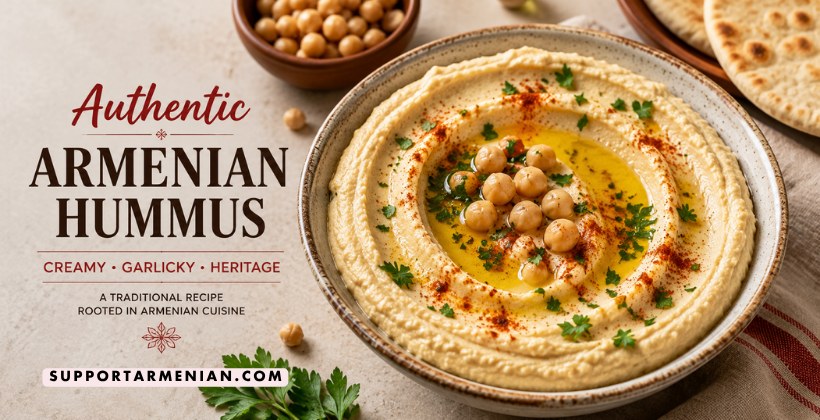
If you've ever been to an Armenian gathering — a birthday, a Sunday barbecue, a holiday table — you've seen it: a generous plate of hummus, swirled smooth, drizzled with olive oil, and surrounded by warm pita or lavash. While hummus originated in the broader Middle East, Armenian families have made it their own for generations, serving it alongside lahmajun, kebab, fresh vegetables, and whatever else is coming off the grill. It's the quiet staple that ties the whole spread together.
Ingredients
- 1 can (15 oz) chickpeas, drained and rinsed (reserve the liquid / aquafaba)
- 3 tbsp tahini, well-stirred
- Juice of 1 large lemon
- 1–2 cloves garlic
- 2 tbsp olive oil, plus more for serving
- ½ tsp kosher salt
- ¼ tsp cumin
- 2–3 tbsp reserved chickpea liquid (aquafaba), or ice water
- Garnish: paprika, chopped parsley, whole chickpeas, sumac (optional)
Instructions
- Peel the chickpeas (optional but recommended). After draining and rinsing, rub the chickpeas between your palms or inside a clean towel to loosen the skins, then pick out and discard the skins. It takes about 5 extra minutes but makes a noticeably smoother, creamier hummus.
- Mellow the garlic. Drop the garlic cloves into the lemon juice and let them sit for 10 minutes while you prep everything else. The acid tames the raw bite so you get full garlic flavor without the sharp sting.
- Blend the chickpeas. Add the chickpeas to a food processor and pulse 8–10 times until broken down into a coarse, crumbly texture.
- Add tahini, lemon-garlic, and spices. Pour in the tahini, the lemon juice with garlic, kosher salt, and cumin. Process for 1 minute until the mixture comes together into a thick paste, scraping down the sides once.
- Drizzle in the olive oil. With the processor running, slowly stream in the olive oil. Let it blend about 1 minute until fully incorporated and the mixture lightens in color.
- Add aquafaba for a silky texture. With the processor still running, add the reserved chickpea liquid (or ice water for an even lighter texture) one tablespoon at a time. This whips air into the mixture and loosens it to the perfect creamy consistency.
- Blend for 3–4 minutes total. Let the processor run continuously for 3–4 minutes, scraping down the sides once or twice. Yes, that long — the longer it blends, the smoother and silkier the hummus becomes.
- Taste and adjust. Taste for salt and acidity. Add more lemon juice for brightness or a pinch more salt if it tastes flat. If it's too thick, blend in another tablespoon of water or aquafaba.
- Plate and garnish. Spread the hummus on a wide, shallow plate using the back of a spoon, dragging it in a circular motion to create the classic well in the center. Drizzle generously with olive oil, dust with paprika, scatter chopped parsley and a few whole chickpeas over the top, and finish with a light sprinkle of sumac if using.
Tips for the Best Hummus
Serve with warm pita, fresh lavash, or a plate of cut cucumbers, tomatoes, radishes, and bell peppers — it pairs perfectly with Armenian khorovats, lahmajun, or a full mezze spread with baba ganoush and tabbouleh. Every Armenian family has their own version — a little more garlic here, extra lemon there, maybe a drizzle of pomegranate molasses on top — so once you've nailed this base, taste as you go and make it yours. Leftovers keep well covered in the fridge for up to 5 days; let it come to room temperature before serving for the best texture.