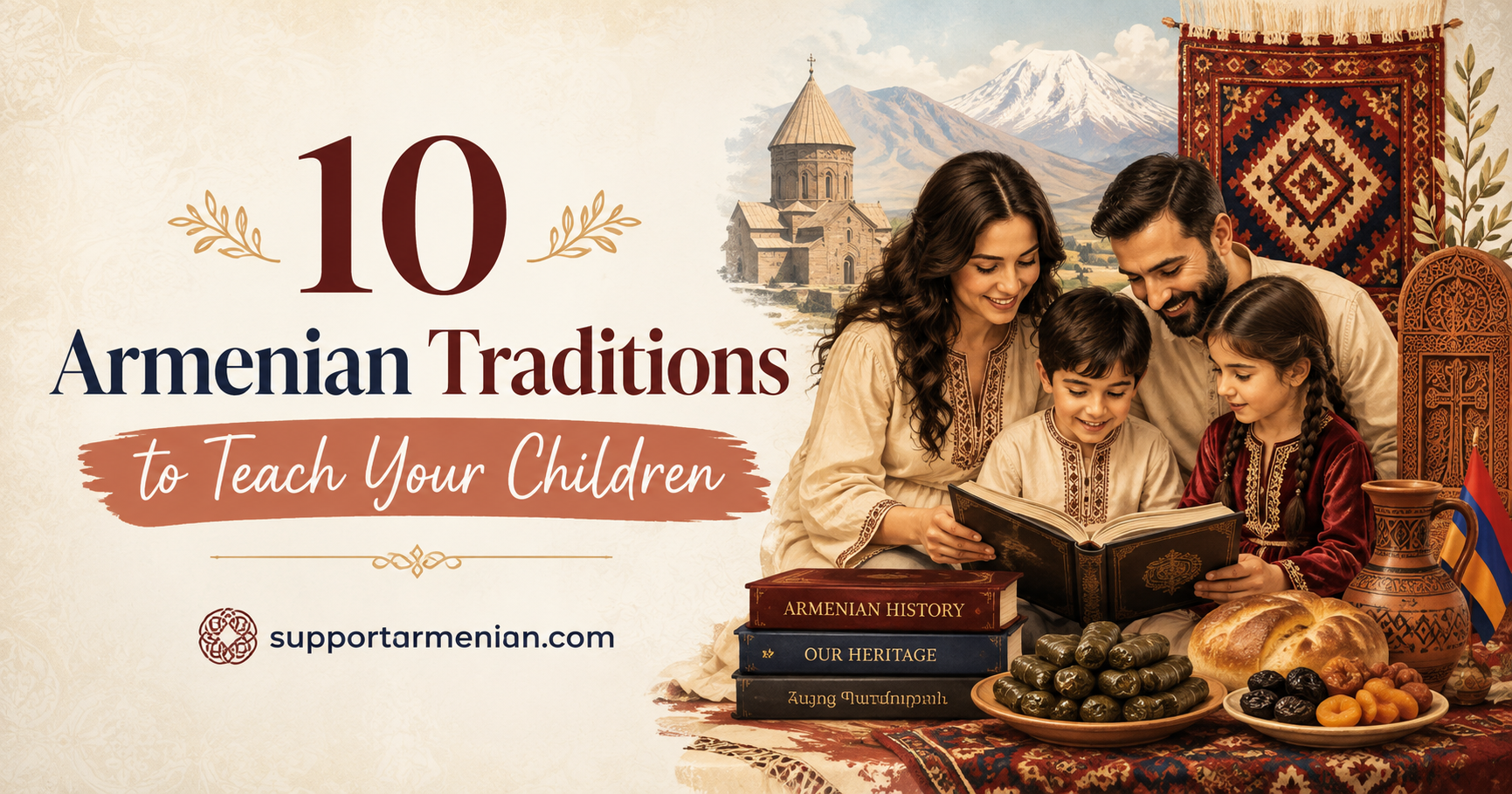
Culture doesn't survive on its own. It survives because parents make a choice, over and over, to pass it down. For Armenian families in the diaspora, that choice is especially deliberate. There is no Armenian street outside your door, no Armenian school down the block, no national holiday on the official calendar. What your children know about who they are comes almost entirely from what you show them at home.
The good news is that keeping Armenian culture alive doesn't require grand gestures. It happens in the kitchen, at the dinner table, in the songs you play on a Saturday morning, in the stories you tell before bed. Here are ten traditions worth starting, continuing, or returning to.
Speaking the Armenian Language
Language is the most direct line to a culture. When children speak Armenian, they gain access to centuries of poetry, prayer, music, and humor that doesn't translate. Even if your own Armenian is imperfect or rusty, speaking it at home is worth it. Start small: greetings, family names, mealtime words. Armenian Saturday schools exist in most major diaspora cities — Los Angeles, Boston, Detroit, Toronto, Sydney — and many offer classes for young children. For older kids, apps like Ling and Pimsleur have Armenian courses. The goal isn't fluency by age five. The goal is for Armenian to feel like a natural part of their world.
Celebrating Armenian Holidays
Armenian Christmas falls on January 6, the Feast of the Epiphany, and is one of the oldest continuous Christian celebrations in the world. Armenian Easter brings the Blessing of the Grapes in some communities. April 24, Armenian Genocide Remembrance Day, is observed with solemnity and is one of the most important dates on the Armenian calendar. Vardavar, in late July, is a water festival rooted in pre-Christian Armenian tradition. Celebrating these holidays, even simply, teaches children that their heritage has its own rhythm and calendar, distinct from the mainstream. Light a candle, cook a traditional dish, attend a community event, and explain why the day matters.
Making Armenian Traditional Foods Together
Food is memory. The smell of manti steaming, the rhythm of rolling lahmajoun dough, the patience of stuffing grape leaves — these experiences embed themselves in children in a way that no lesson can. Get them in the kitchen. Let them roll dolma. Let them shape gata. Teach them the difference between Eastern and Western Armenian cooking, and tell them which dishes came from which side of your family. When they are grown and make those dishes themselves, they will remember. Food is one of the most durable ways culture travels from one generation to the next.
Armenian Dance and Music
Armenian folk dance, known as kochari, tamzara, and yarkhushta, among others, is athletic, communal, and joyful. Many Armenian community centers and churches offer folk dance classes for children, and performing in a group is one of the most effective ways for diaspora kids to feel connected to something larger than themselves. Music works the same way — the duduk, the dhol, Armenian folk songs, and contemporary Armenian artists all open doors. Play Armenian music in the car, at dinner, on holidays. Let it become background music to their childhood.
Respecting Elders and Family
In Armenian culture, elders are treated with genuine deference, not just politeness. Grandparents, great-aunts, family friends of an older generation — they are addressed formally, served first, and listened to. This is not just etiquette. It is a transmission of values: that age carries wisdom, that family loyalty is non-negotiable, that caring for those who raised you is an obligation and a privilege. Model this behavior for your children. Visit grandparents regularly. Involve elders in family decisions. Teach children to sit with older relatives and ask them questions about the past. Those conversations, once lost, cannot be recovered.
Learning About Armenian History
Children need to understand where they come from, including the painful parts. The Armenian Genocide of 1915, in which 1.5 million Armenians were killed by the Ottoman Empire, is central to the modern Armenian identity. Teaching children about it — age-appropriately, with honesty and context — is not a burden. It is a responsibility. Beyond 1915, Armenia's history is rich: one of the world's oldest Christian nations, a survivor of countless empires, the home of Hagia Sophia-era monasteries, ancient khachkars, and a literary tradition stretching back to the 5th century. Start with a children's book. Visit a genocide memorial. Answer their questions honestly.
Celebrating Armenian Weddings and Traditions
An Armenian wedding is not just a party. It is a cultural event with specific rituals, music, dances, and customs that vary by region and family. The kef (celebration), the khosk-kap (engagement), the bread-and-salt welcome, the dancing that goes until 2am — these are experiences children absorb when they attend. Take your children to Armenian weddings and explain what they're seeing. When the time comes for their own celebrations, they'll know what a real Armenian wedding looks and feels like, and they'll want to carry those traditions forward.
Teaching Armenian Folktales and Stories
Armenian oral tradition is rich with stories, fables, and legends. Figures like Sasuntsi Davit (David of Sasun), the epic hero of Armenia's national epic poem, give children mythological roots as deep as any other culture's. Armenian folktales often feature clever children, wronged villagers, and the importance of integrity, generosity, and courage. Reading these stories together, or telling them from memory, places your child inside a 3,000-year-old storytelling tradition. Look for Armenian children's books in both Eastern and Western Armenian. Some are available on Amazon and through diaspora publishers.
Supporting Armenian-Owned Businesses
One of the most practical ways to keep Armenian culture alive is to spend money within the community. When your family shops at an Armenian bakery, books an Armenian photographer, hires an Armenian contractor, or eats at an Armenian restaurant, you are doing more than making a purchase. You are reinforcing a community's economic foundation, which is what allows that community to sustain itself. Teach your children to notice when a business is Armenian-owned, and explain why it matters. SupportArmenian.com lists hundreds of Armenian-owned businesses across the Los Angeles area and beyond, making it easy to find and support community members.
Keeping Armenian Culture Alive in Everyday Life
The tenth tradition is all the small things that don't fit neatly into a category: saying bari louys (good morning) in Armenian, hanging a cross or a pomegranate ornament in your home, reading a poem by Siamanto or Charents, following Armenian news, attending church even occasionally, joining a community organization, traveling to Armenia if you can. Culture is not preserved in museums. It is preserved in habits. Every small daily choice to incorporate Armenian identity into ordinary life adds up, and children who grow up surrounded by those habits absorb them without even trying. That is how a culture survives.
A Final Word
You don't have to do all ten of these at once. Pick one or two that feel natural and start there. The goal is not to re-create Armenia in your living room. The goal is to make sure your children grow up knowing they belong to something ancient, resilient, and worth preserving. That sense of belonging is one of the greatest gifts you can give them.
Հայ մնա — Stay Armenian. The phrase is simple, but the commitment behind it is everything.
Support Armenian-Owned Businesses
Browse hundreds of Armenian-owned businesses across Los Angeles and beyond.