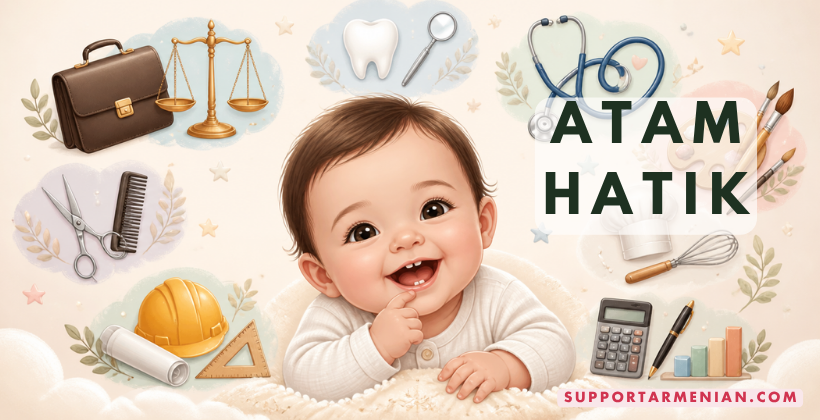
Somewhere around a baby's first birthday, most families are busy planning a cake smash and a party theme. Armenian families are doing that too — but they're also setting a tray full of random objects in front of the baby: a stethoscope, a stack of cash, a hairbrush, maybe a wooden spoon or a calculator. Then everyone leans in, phones out, waiting to see which one the baby grabs first.
This is Atam Hatik (Ատամ Հատիկ), also known by its Western Armenian name Agra Hadig (Ակռա Հատիկ) — the celebration of a baby's first tooth, and the moment the family "discovers" what that baby is destined to become. It's part milestone party, part fortune-telling, and entirely one of the most fun traditions in Armenian culture.
What Is Atam Hatik (Agra Hadig)?
Atam Hatik marks the arrival of a baby's very first tooth — a moment nearly every culture celebrates in some form, since it signals a baby is growing, teething, and about to start eating solid foods. In Armenian tradition, this milestone gets its own small celebration, usually held with close family, sometimes folded into the child's first birthday if the timing lines up.
The centerpiece of the tradition is a ritual that will feel familiar to anyone who has seen a Korean doljabi or a similar "future-telling" ceremony from other cultures: a tray or table is set with a handful of everyday objects, each one symbolizing a different profession, personality trait, or path in life. The baby is placed in front of the tray and left to reach for whatever catches their eye. Whatever they touch first is treated — half-seriously, half-jokingly — as a sign of what they'll grow up to become.
No one actually expects a one-year-old's grab at a toy stethoscope to determine a medical career. But that's not really the point. The point is gathering the family together, laughing, taking a hundred photos, and marking the moment a baby is growing into their own person.
Where Does the Name Come From?
Like a lot of Armenian vocabulary, the name of this tradition depends on which dialect your family speaks. Atam is the Eastern Armenian word for "tooth," while Agra (sometimes written Akra) is the Western Armenian equivalent. Hatik (or Hadig) means "grain" or "seed" — a reference to boiled wheat, the traditional dish served at this celebration, whose small, tooth-like kernels are a fitting way to mark a baby's first tooth pushing through.
So whether your family says Atam Hatik or Agra Hadig, you're saying the same thing: "tooth grain." Both versions describe the exact same tradition — the difference is purely dialectal, the same way "Ապրես" and "Աբրես" (both meaning "well done" or "bravo") vary between Eastern and Western Armenian speakers.
When Is It Celebrated?
Most babies get their first tooth somewhere between 4 and 12 months old, so Atam Hatik doesn't happen on a fixed date the way a birthday does — it happens whenever that first tooth actually appears. Some families celebrate it right away, as a small, spontaneous gathering. Others wait and combine it with the baby's first birthday party if the timing is close, especially since both milestones tend to call for the same crowd of grandparents, aunts, uncles, and family friends.
Either way, it's treated as a genuine milestone — proof the baby is thriving, teething, and about to move into a whole new stage of eating, babbling, and (soon enough) walking.
The Tray of Objects: How the Ritual Works
The heart of Atam Hatik is the object tray — sometimes it's an actual serving tray, sometimes a blanket spread out on the floor, sometimes a fancy custom-built table set up for photos. Family members arrange a set of small objects in front of the baby, each one standing in for a different future. The baby is set down (sometimes with a parent steadying them) and everyone watches to see what they reach for first.
Planning an Atam Hatik? Here Are Some Ideas of Things to Put Out for Your Baby Boy or Girl
- Money (cash or coins) — a future in business, finance, or simply a life of wealth and stability.
- A stethoscope — a future doctor.
- A small toothbrush — a future dentist.
- A book or pen — a scholar, teacher, or writer.
- Gravel — a future lawyer.
- A calculator or ruler — an engineer, architect, or accountant.
- A toy hard hat or small tools — a future construction worker or contractor.
- A keyboard or small laptop — a future programmer or tech worker.
- A wooden spoon or small kitchen tool — a future chef or someone who loves to cook.
- A ball or other sports item — a future athlete.
- A microphone or instrument — a future singer or musician.
- A paintbrush or sketchbook — a future artist.
- Fabric swatches or a small sketchpad — a future designer.
- A hairbrush — a future hairstylist.
- A makeup brush — a future makeup artist.
- Jewelry or a mirror — sometimes said to predict beauty, vanity, or a love of fashion (usually said with a laugh).
- A car key or toy car — a future driver, traveler, or someone who loves to be on the move.
Shop Career Toys for Your Atam Hatik Tray
Rather than hunting around the house for props, these multicultural career playsets work perfectly as tray objects and double as a thoughtful keepsake gift after the celebration.

$18.99 (price may change)
Shop on Amazon →
$35.99 (price may change)
Shop on Amazon →
$21.99 (price may change)
Shop on Amazon →Don't want to put out actual objects? You can always write the occupations on slips of paper instead and let the child choose one that way.
Families often get creative and add their own items — a laptop for a future tech worker, a passport for a future traveler, or a tiny chef's hat for the family foodie. There's no official list; part of the fun is customizing the tray to reflect what the family actually cares about, jokes about, or hopes for.
Hadig: The Boiled Wheat Behind the Name
The tradition takes half its name from hadig (also called hadigov, or in some households, a version close to anushabur), a dish of boiled whole wheat kernels, often sweetened and topped with cinnamon, sugar, pomegranate seeds, nuts, or dried fruit. It's the same base grain used in dishes served at other Armenian milestones and remembrances, and its small, hard kernels are the direct visual echo of a baby's first tooth pushing up through the gums.
At an Atam Hatik gathering, hadig is often scattered playfully over the baby's head or shoulders by the grandparents — a lighthearted blessing for health, growth, and abundance — while everyone laughs, takes photos, and showers the baby (and usually the very patient parents) with well wishes.
How Families Celebrate Today
Modern Atam Hatik celebrations have grown well beyond a quiet tray of objects at the kitchen table. Many Armenian families now treat it as a full mini-event: a themed dessert table, custom balloon arches, professional photography, and — increasingly — custom decorated cookies shaped like tiny stethoscopes, books, musical notes, and dollar bills, so even the treats echo the fortune-telling objects on the tray. It's become common enough that Armenian bakers across Los Angeles specifically list Atam Hatik sets among their most-requested custom orders, right alongside weddings and baby showers.
Some families keep it intimate — just parents, grandparents, and siblings gathered around a blanket on the living room floor. Others invite extended family and close friends for a full party, complete with a dedicated table for the object tray so every guest can watch (and record) the big grab. Either way, the moment tends to become one of those stories a family retells for years: what the baby picked, what everyone predicted, and whether — twenty years later — it actually came true.
A Tradition Rooted in Hope
At its core, Atam Hatik isn't really about fortune-telling. It's about gathering the people who love a child most, marking a small physical milestone (a literal tooth) with a moment of collective hope for everything that child might become. It's playful, a little superstitious, and completely sincere all at once — which is true of a lot of Armenian traditions. The stethoscope a baby grabs at eleven months old doesn't decide their career. But the aunts, uncles, and grandparents crowded around that tray, cheering and laughing and already planning how to tell the story later, are doing exactly what the tradition is for: welcoming a new person into the family with love, humor, and a whole lot of hope.