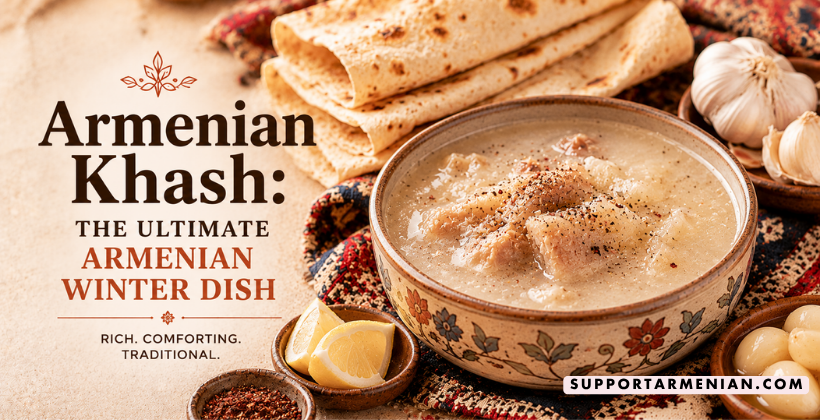
There are dishes you eat, and then there are dishes you experience. Khash (խաշ) belongs firmly in the second category. It is a slow-cooked broth made from beef trotters — the feet and sometimes the head — simmered through the night until the collagen dissolves and the broth becomes rich, white, and deeply gelatinous. It is eaten in the early morning hours of winter, usually with vodka or arak, surrounded by family and friends, with lavash crumbled into it and a raw garlic clove on the side. It is one of the oldest dishes in Armenian cuisine, and it remains one of the most beloved. Be honest with yourself before you start: this is a real overnight project, not a weeknight dinner, but the payoff is a broth unlike anything else in Armenian cooking.
The Culture of Khash
Khash is not just a recipe — it's an event. Traditionally, it was eaten in the coldest months of the year, from late November through February, because that's when the dish is most suited to the body and the mood. The preparation begins the night before: the trotters are cleaned, soaked, and set to cook on a low flame before the household goes to sleep. By morning, the house smells of rich, meaty broth. Guests arrive early — khash is a morning dish, typically eaten between 8 and 10am — and the table is set with lavash, garlic, radishes, and fresh herbs. Shots of vodka or homemade arak are poured. And then, together, you eat.
In Armenia, khash season is treated like a social institution. People make plans around it, invite friends weeks in advance, and arrive early in the morning specifically for a bowl.
The dish also carries historical and class resonance. It was originally food of the poor — made from parts of the animal that wealthier households discarded. Over centuries, khash was transformed into a beloved tradition that crosses all social lines. Today it is eaten everywhere, from village homes to Yerevan restaurants, and the fact that it takes hours of work makes the communal aspect feel even more meaningful.
Ingredients
- 3–4 lbs beef trotters (front feet), cleaned and split by your butcher
- Optional: 1–2 lbs beef knuckle bones or marrow bones, for added richness
- 4–5 quarts cold water, enough to cover the trotters generously
- Salt, added only at the very end of cooking
- To serve: dried lavash (crumbled or torn), 4–6 raw garlic cloves, fresh parsley or tarragon, sliced radishes, fresh lemon wedges, white wine vinegar, dried chili or Aleppo pepper (optional), and Armenian string cheese on the side
Instructions
- Clean the trotters. Rinse the trotters thoroughly under cold running water. If there are any hairs remaining, hold them briefly over an open flame or use a kitchen torch to singe them off, then scrub the skin clean with a brush.
- Soak overnight (or at least 6–8 hours). Place the cleaned trotters in a large bowl or pot and cover completely with cold water. Let them soak, changing the water 2–3 times, to draw out residual blood and impurities. Skipping this step is what turns a clean white broth into a gray, funky one — don't rush it.
- Drain and start the pot. Drain, rinse once more, and transfer the trotters (plus any optional marrow bones) to your largest stockpot. Cover generously with 4–5 quarts of fresh cold water. Bring to a full boil over high heat, uncovered.
- Skim aggressively for the first 20 minutes. As the pot comes to a boil, a heavy gray foam will rise to the surface. Skim it off continuously with a large spoon or fine mesh skimmer until the liquid runs mostly clear. This is the final purge of impurities — do not skip it or walk away during this stage.
- Reduce to the lowest possible simmer. Once the broth is clear, drop the heat all the way down. You're aiming for barely a bubble breaking the surface every few seconds, not a rolling simmer. Cover with the lid slightly ajar to let a little steam escape.
- Cook low and slow for 6–10 hours. This cannot be rushed — six hours is the bare minimum, and eight to ten hours produces a noticeably richer, whiter broth. If you start around 9 or 10pm, it will be ready by breakfast. The meat should be falling-apart tender and the broth thick, opaque, and milky white with dissolved collagen.
- Salt only in the final 30 minutes. Adding salt earlier toughens the connective tissue and slows collagen breakdown, so hold off until the very end. Season generously, taste, and adjust.
- Pull the meat and finish the broth. Using tongs, lift out the trotters, pull any usable meat from the bones, and return that meat to the pot. Discard the bones. The finished broth should be glossy and coat the back of a spoon — if it feels thin, simmer it uncovered another 20–30 minutes to concentrate it further.
How to Eat Khash
This is as important as making it. Ladle the hot broth and meat into deep bowls. Then at the table, each person customizes their own bowl the way they like it. The classic approach:
- Crumble dried lavash directly into the bowl — it softens in the broth and becomes silky and nourishing.
- Peel a raw garlic clove and rub it around the rim of the bowl, then drop it in. Some people crush it directly into the broth. The garlic is pungent and essential — it cuts through the richness.
- Add a splash of white vinegar for acidity.
- Scatter fresh herbs over the top.
- Season with additional salt, a squeeze of lemon, or a pinch of dried chili.
At the Armenian table, khash is traditionally accompanied by a shot of vodka or arak — taken before and sometimes during the meal. The logic is practical: the high-fat, high-collagen broth coats the stomach and makes the drink easier on the body. Whether or not you partake, the social ritual around the shots is part of what makes a khash gathering feel distinct and memorable.
Notes on the Modern Kitchen
If you have a slow cooker, it's actually very well-suited for khash — set it to low, load the cleaned trotters and water in the evening, and let it run overnight. You'll still need to skim when it first comes to heat, but the slow cooker's gentle, consistent temperature produces an excellent broth.
A pressure cooker or Instant Pot can reduce the cooking time to 3–4 hours at high pressure, though the broth won't develop quite the same depth and the texture is slightly different. If you're short on time, it's a workable shortcut — but plan ahead for the proper version when you can.
Khash freezes beautifully. The cooled broth will solidify into a firm, gelatinous mass in the refrigerator — this is a sign of quality, not a problem. Reheat it slowly on the stove. It keeps in the freezer for up to three months.
Tips for the Best Khash
Buy your trotters from a butcher who will clean and split them for you — it saves real effort and most Middle Eastern or Armenian markets carry them already prepped. Never let the broth boil hard once it's past the skimming stage; a hard boil emulsifies the fat into the broth and makes it greasy instead of silky. And resist the urge to salt early — an under-salted broth you fix at the table is far better than a tough, over-salted one you can't undo.
If you've never had khash, prepare yourself: it is unlike anything else. It is deeply satisfying in a way that feels almost primal — slow food, in every sense of the word, made from humble ingredients and an enormous amount of patience. Once you've experienced it properly, with the lavash and the garlic and the cold morning and the company, you'll understand why Armenians treat khash season as something worth looking forward to all year.