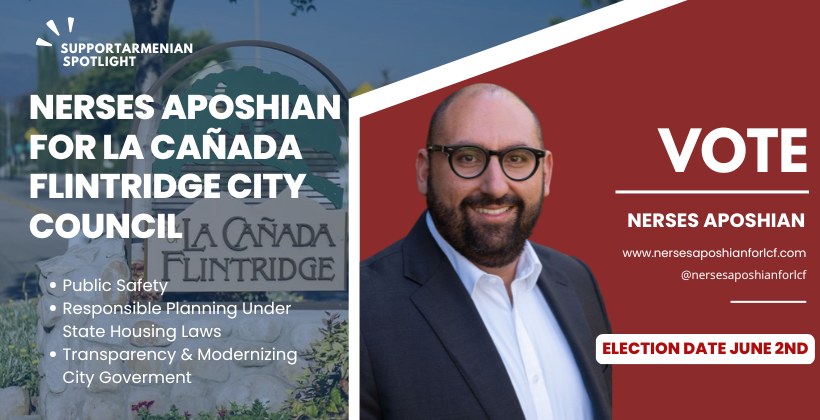
La Cañada Flintridge is at a turning point. State housing laws are reshaping what cities can and cannot decide locally. Fire risk, traffic, and infrastructure pressures are growing. And residents want leaders who understand the details — not just the politics.
One of the candidates on the ballot this June is Nerses Aposhian — a longtime LCF resident, current Planning Commissioner, commercial real estate professional, and chair of the Merdinian Armenian Evangelical School Board. If elected, he would become the first Armenian-American ever elected to the La Cañada Flintridge City Council.
We sat down with Nerses to talk about why he's running, what he'd prioritize on Day 1, and what residents should know about the issues facing the city.
Q&A with Nerses Aposhian, Candidate for La Cañada Flintridge City Council
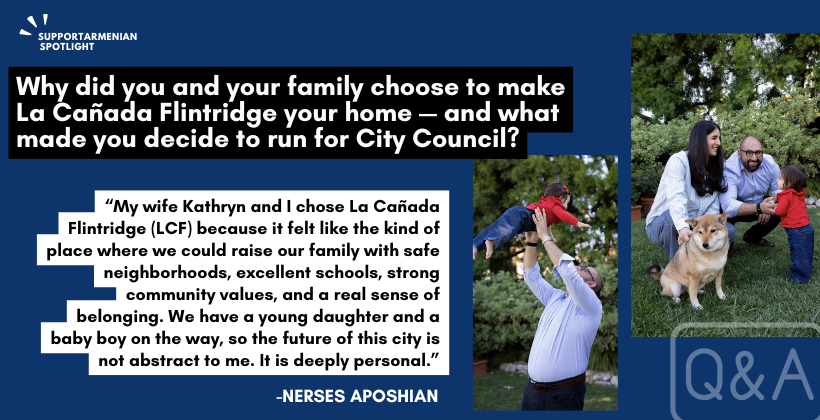
My wife Kathryn and I chose La Cañada Flintridge (LCF) because it felt like the kind of place where we could raise our family with safe neighborhoods, excellent schools, strong community values, and a real sense of belonging. We have a young daughter and a baby boy on the way, so the future of this city is not abstract to me. It is deeply personal.
What I love most about LCF is that it still feels like a true small town. People know each other. Families are invested. Neighbors show up. Whether it is at a school event, a local restaurant, a community meeting, or just walking around town, you feel that people genuinely care about this place and want to protect what makes it special.
Serving on the Planning Commission gave me a much deeper understanding of the issues facing our city: housing, public safety, wildfire risk, infrastructure, traffic, and the balance between responsible planning and preserving neighborhood character. It also showed me how important it is to have leaders who are prepared, ask tough questions, understand land use, and are willing to make practical decisions based on facts, not politics.
That is a big reason I decided to run for City Council. I believe my background in commercial real estate, planning, business, and community leadership can be helpful at a time when LCF is facing real pressure from state housing laws, infrastructure needs, public safety concerns, and quality-of-life issues. I am running because I want to help protect the city we love while ensuring we plan responsibly for the next generation.
And on a personal note, if elected, I would be the first Armenian-American ever elected to the La Cañada Flintridge City Council. As someone raised in the Armenian community and now raising my own family here, I would find that a tremendous honor. But more than anything, I am running to serve all LCF residents with independence, thoughtfulness, and deep respect for this community.
Residents should pay close attention to how state housing laws affect local control, especially when projects become ministerial or streamlined, and the city has less discretion than people may expect.
That does not mean the city is powerless. It means we need to be very clear about where we still have authority and how we use it. In my view, the most important area is public safety.
On Day 1, I want to address the fact that LCF does not currently have a clear objective standard for public safety to evaluate future housing projects, especially projects on Housing Element sites. We need one. If the state is going to limit local discretion in certain cases, the city needs strong, objective standards in place to properly evaluate fire access, evacuation, traffic circulation, emergency response, infrastructure, and neighborhood safety.
Planning is not just about approving buildings. It is about ensuring projects are safe, responsible, and compatible with the surrounding community. The more state law limits local control, the more important it becomes for LCF to be proactive, prepared, and clear about the standards that protect its residents.
Merdinian is deeply personal to me. I attended the school for 11 years, from preschool through 8th grade, and my grandfather served as one of its first principals in the early 1980s. So my commitment to the school is not just as a board member. It is part of my family story and who I am.
I have now served on the Merdinian Board for seven years, including the last three as Chair, and during that time I have had to wear just about every hat: education, finance, fundraising, strategic planning, facilities, capital improvements, parent communication, event planning, marketing, and everything in between.
The biggest lesson is that leadership requires listening, planning, accountability, and follow-through. At Merdinian, growth did not happen by accident. It required building trust, supporting great teachers, improving the student and parent experience, investing in facilities and programs, and making financially responsible decisions.
That experience carries over directly to city government. A city has to listen to residents, respect staff, manage budgets carefully, invest in infrastructure, and make decisions that serve the long-term health of the community. You cannot just have a vision. You have to execute.
Whether it is a school or a city, people want to know that leadership is transparent, thoughtful, financially disciplined, and focused on results. And culture matters. When people feel heard, respected, and informed, the whole community functions better.
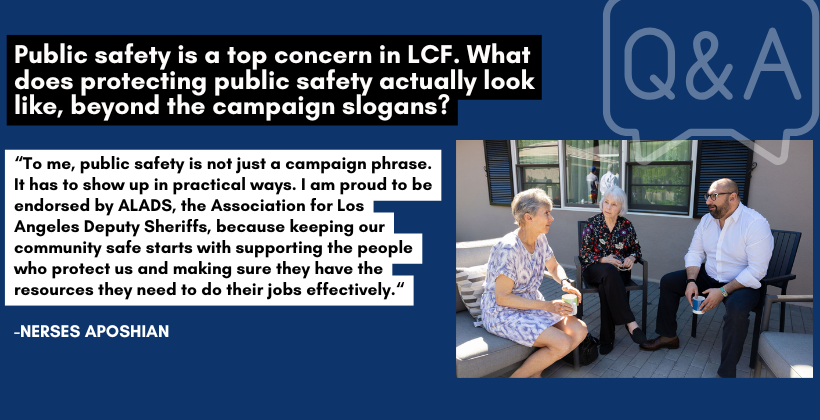
To me, public safety is not just a campaign phrase. It has to show up in practical ways.
I am proud to be endorsed by ALADS, the Association for Los Angeles Deputy Sheriffs, because keeping our community safe starts with supporting the people who protect us and making sure they have the resources they need to do their jobs effectively.
But public safety is also much broader than law enforcement. It means supporting strong fire and emergency services, maintaining response times, and making sure our city has real emergency preparedness plans in place. It also means infrastructure: safe roads, evacuation routes, traffic circulation, brush clearance, fire access, stormwater systems, and making sure new development does not create safety problems the city failed to anticipate.
In a high-fire-risk community like ours, public safety has to be part of every major planning conversation. We need to ask basic but important questions: Can emergency vehicles access the site? Can residents evacuate safely? Is the infrastructure there to support the project? Are we doing enough to prepare families before an emergency happens?
For me, protecting public safety means being proactive, not reactive.
I want to be very honest about this: I have never been an elected official before, so there will be a lot to learn. I plan to listen, ask questions, lean on city staff, and learn from those who came before me, including current councilmembers and former Mayors like Mike Davitt, Steve Del Guercio, Greg Brown, Rick Gunter, and Len Pieroni, all of whom have endorsed me.
I also understand that one councilmember does not run the city alone. If elected, I would be one of five councilmembers, and my goal would be to work collaboratively with the other four to make thoughtful, practical decisions for La Cañada Flintridge.
One of the first issues I would want to focus on is the need for a clear, objective public safety standard, especially as we evaluate future housing projects on Housing Element sites. As state housing laws limit local discretion, we need to be very clear about where the city still has authority. Public safety is one of those areas.
That means looking carefully at fire access, evacuation, emergency response, traffic circulation, infrastructure capacity, and neighborhood safety. I would want to work with staff, residents, public safety experts, and my fellow councilmembers to identify where our current standards are strong, where there are gaps, and what we can do to better protect residents going forward.
I would also want to better understand how the city currently uses technology and where we can improve. Whether it is communication with residents, permitting, emergency alerts, public records, service requests, or making city information easier to access, technology should help make local government more efficient, transparent, and user-friendly.
So in the first 90 days, my focus would be simple: listen, learn, build relationships, understand the city's priorities, and start working with the full Council on practical steps to protect public safety, improve transparency, modernize how the city serves residents, and preserve the quality of life that makes LCF special.

How to Vote
The LCF City Council election is Tuesday, June 2, 2026. To make a plan to vote:
- 🗺️ Find your nearest vote center (LA County's official locator)
- 📬 If you received a Vote By Mail ballot, you can return it by mail, drop it in any official drop box, or bring it to a vote center
- 📅 In-person voting is open in the days leading up to Election Day — check your assigned center for hours
Connect with Nerses
- 🌐 nersesaposhianforlcf.com
- @nersesaposhianforlcf on Instagram
- Nerses Aposhian for LCF on Facebook
Nerses Aposhian for LCF City Council
Make your voice heard. Election Day is Tuesday, June 2.