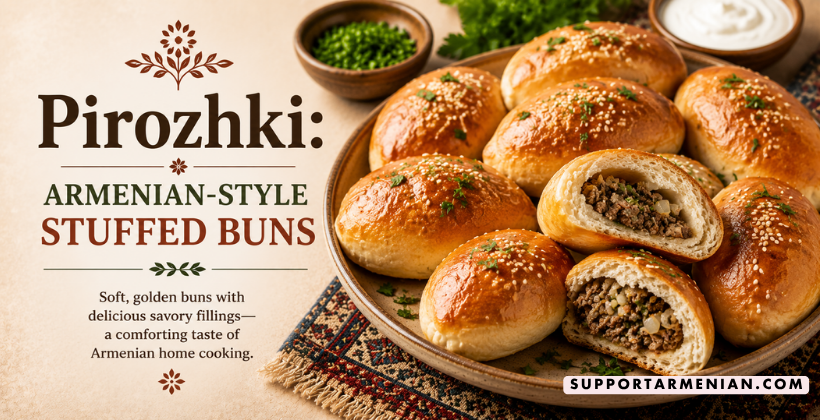
There are few things as satisfying as a tray of freshly baked pirozhki coming out of the oven — golden on top, soft all the way through, and stuffed with a filling that perfumes the whole kitchen. Pirozhki (singular: pirozhok) are yeasted buns filled with either savory or sweet fillings, and they've become deeply embedded in Armenian home cooking through generations of cultural exchange with Russian and Eastern European neighbors. In Armenian households, they show up at Sunday lunches, at church socials, and tucked into school bags as the most enviable lunch possible.
Pirozhki in the Armenian Kitchen
The word "pirozhki" comes from the Russian "пирожки," and the dish traveled into Armenian cooking during the Soviet era and through the diaspora communities of Los Angeles, Paris, and beyond. But Armenians didn't simply adopt it — they adapted it. Armenian pirozhki tend to be on the softer, enriched side, often baked (though some families fry them), and the fillings reflect what's available and what's beloved: spiced ground meat with caramelized onion, or potato mashed with butter and dill.
Once you master the dough, pirozhki become one of the most flexible recipes in your kitchen — the filling can change every time.
Ingredients
Dough (makes 16 buns)
- 2¼ tsp active dry yeast (1 packet)
- 1 cup whole milk, warmed to about 110°F
- 1 tbsp granulated sugar
- 3½ cups all-purpose flour
- 1 tsp salt
- 2 large eggs (1 for the dough, 1 beaten for egg wash)
- 4 tbsp unsalted butter, softened
Meat Filling
- 1 lb ground beef or lamb
- 1 large onion, finely diced
- 2 tbsp vegetable oil
- ½ tsp black pepper
- ½ tsp ground cumin
- ½ tsp paprika
- Salt, to taste
- ¼ cup fresh parsley, chopped
Potato Filling
- 4 medium russet potatoes, peeled and cut into chunks
- 3 tbsp unsalted butter
- ¼ cup warm milk
- 1 small onion, finely diced and sautéed until golden
- Salt and black pepper, to taste
- 2 tbsp fresh dill or chives, chopped
Note: each filling recipe makes enough for one full batch of dough (16 buns). If you want to make both, halve each filling recipe so you have enough dough for 8 of each.
Instructions
- Bloom the yeast. Warm the milk to about 110°F — it should feel warm but not hot on your wrist. Stir in the sugar and yeast. Let it sit for 10 minutes until foamy and fragrant. If it doesn't foam, the yeast is dead — start over with a fresh packet.
- Mix the dough. In a large bowl, combine the flour and salt. Make a well in the center, add the yeast mixture and one beaten egg, and stir until a shaggy dough forms.
- Knead in the butter. Turn the dough out onto a lightly floured surface and knead for 6–8 minutes until smooth and elastic. Add the softened butter a tablespoon at a time as you knead — each addition takes a minute to fully incorporate, but the result is worth it.
- First rise. Place the dough in a lightly oiled bowl, cover with a clean towel, and let it rise in a warm spot for 1 to 1.5 hours until doubled in size.
- Cook the meat filling. Heat oil in a skillet over medium-high heat. Add the diced onion and cook until deeply golden, 12–15 minutes — don't rush this, the caramelization is the flavor base. Add the ground meat, breaking it up with a spoon, and cook until browned with no pink remaining, about 8 minutes. Season with black pepper, cumin, paprika, and salt, then stir in the parsley. Let cool completely before using — warm filling will make the dough soggy.
- Or make the potato filling. Boil the potatoes in salted water until fork-tender, about 20 minutes, and drain well. In a separate pan, sauté the diced onion in butter until golden and soft, about 8 minutes. Mash the potatoes with butter and warm milk until smooth, fold in the sautéed onion, season generously with salt, pepper, and dill or chives, and let cool completely.
- Shape the buns. Preheat the oven to 375°F and line two baking sheets with parchment. Punch down the risen dough and divide into 16 equal pieces. Flatten each piece into a circle about 4 inches across — not too thin, or it will tear. Place a generous tablespoon of cooled filling in the center, bring the edges up, and pinch firmly to seal. Place seam-side down on the sheet, leaving about 2 inches between buns.
- Rest and egg wash. Cover the shaped buns loosely and let them rest 20 minutes — they'll puff slightly. Beat the remaining egg with a tablespoon of water and brush each bun generously; this gives them their glossy mahogany color.
- Bake. Bake at 375°F for 20–24 minutes until deep golden brown. Check that the undersides are fully set by lifting one with a spatula. Cool on a rack for at least 10 minutes before eating.
Tips for the Best Pirozhki
If you prefer the fried version — and many Armenian households do — shape the buns the same way, then heat about 2 inches of neutral oil in a deep skillet to 350°F and fry a few at a time, seam-side down first, for 2–3 minutes per side until deep golden. Whichever method you use, cool the filling completely before filling (warm filling makes the dough soggy and hard to seal), don't overfill past a heaping tablespoon, and pinch the seams tightly so nothing bursts open in the oven. Pirozhki are best the day they're baked but reheat well at 325°F for 8–10 minutes, and they freeze beautifully — bake fully, freeze on a sheet pan, then reheat from frozen at 350°F for 15–18 minutes. Serve with sour cream or plain yogurt for dipping.