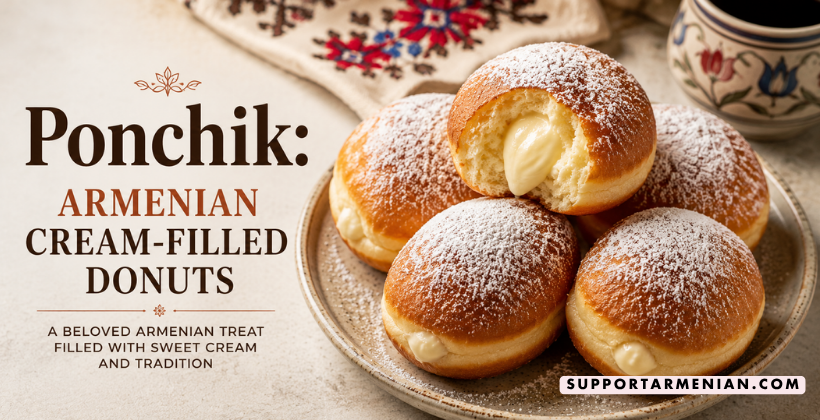
If you've ever walked into an Armenian bakery on a Sunday morning, you know exactly what ponchik is. The display case is stacked with them — round, golden, dusted in a cloud of powdered sugar, filled with a vanilla custard cream that squeezes out the moment you bite in. Ponchik (pronounced pohn-CHEEK) is the Armenian take on the cream-filled donut, and it's one of the most beloved pastries in the community. Every Armenian bakery has their version. This one is made from scratch at home and is every bit as good.
What Is Ponchik?
The name comes from the Russian "pончик" (ponchik), which itself comes from the Polish "pączki" — all referring to the same concept: a deep-fried yeasted dough ball filled with cream or jam and coated in sugar. The Armenian diaspora, shaped by centuries of living alongside Russian and Ottoman cultures, adopted this pastry completely and made it their own. Today, ponchik is as Armenian as lahmajoun or gata. You'll find it at every Armenian deli, every church coffee hour, and every family kitchen where someone's grandma is still frying them on Sunday mornings.
The best ponchik has a paper-thin crispy shell that gives way immediately to a pillowy, airy interior — and filling that goes almost all the way through.
Ingredients
Dough (makes about 12 ponchik)
- 2¼ tsp active dry yeast (1 packet)
- ¼ cup warm water (about 110°F)
- 1 tsp sugar, to bloom the yeast
- 3 cups all-purpose flour
- ¼ cup granulated sugar
- ½ tsp salt
- ½ cup whole milk, warmed
- 2 large eggs, room temperature
- 4 tbsp unsalted butter, softened
- 1 tsp vanilla extract
Vanilla Cream Filling
- 2 cups whole milk
- ½ cup granulated sugar
- 4 large egg yolks
- 3 tbsp cornstarch
- 2 tbsp unsalted butter
- 1½ tsp vanilla extract
- Pinch of salt
Frying & Finishing
- Neutral oil for frying (vegetable or canola), at least 3 inches deep in the pot
- Powdered sugar, for dusting
Instructions
- Make the pastry cream first. Whisk the egg yolks, sugar, and cornstarch together until pale and smooth. Heat the milk in a saucepan over medium heat until steaming, not boiling. Slowly pour the hot milk into the egg mixture while whisking constantly to temper the eggs without scrambling them. Pour everything back into the saucepan and cook over medium heat, whisking constantly, until thickened — 3–5 minutes. It should coat the back of a spoon and hold a trail. Remove from heat, stir in butter and vanilla, then press plastic wrap directly onto the surface and refrigerate at least 2 hours, or overnight.
- Bloom the yeast. Dissolve the yeast and 1 tsp sugar in the warm water. Let sit 5–10 minutes until foamy and fragrant. If it doesn't foam, the yeast is dead — start again with a fresh packet.
- Mix and knead the dough. In a large bowl, combine flour, ¼ cup sugar, and salt. Add the yeast mixture, warm milk, eggs, butter, and vanilla, and mix until a shaggy dough forms. Knead 8–10 minutes until smooth, soft, and slightly tacky — it should pull cleanly away from the bowl. This dough is enriched and softer than a typical bread dough.
- First rise. Cover with a kitchen towel and let rise in a warm spot for 1–1.5 hours until doubled in size.
- Cut and second rise. Punch down the dough and roll to about ¾-inch thickness on a lightly floured surface. Cut rounds with a 2.5-inch cutter. Place on a parchment-lined sheet, cover loosely, and let rise again 30–45 minutes until visibly puffy.
- Fry. Heat oil in a heavy pot to 350°F, using a thermometer to keep it steady — too hot and the outside browns before the inside cooks; too cool and they turn greasy. Fry 2–3 at a time, 2–3 minutes per side, until deep golden brown; they should float and puff as they cook. Drain on a paper towel–lined rack and let cool completely before filling.
- Fill. Transfer the chilled pastry cream to a piping bag fitted with a round tip. Poke a hole into the side of each ponchik with a chopstick or skewer, insert the tip, and pipe in cream, pulling back slowly as you feel it get heavier. Don't overfill or they'll burst.
- Finish and serve. Dust generously with powdered sugar immediately before serving. Ponchik are best eaten the same day — the dough softens by the next morning.
Tips for the Best Ponchik
Oil temperature is everything — keep a thermometer in the pot and let it recover to 350°F between batches, since it drops each time you add more dough. Don't rush the second rise; those 30–45 minutes after cutting are what keep the ponchik light instead of dense, so wait until they look noticeably puffier before frying. Some families fill ponchik with rose jam, apricot jam, or dulce de leche instead of custard — if using jam, skip the pastry cream entirely and pipe in cold jam after frying. And don't be tempted to cut the butter from the dough; the enriched dough is what gives ponchik its signature pillowy, tender crumb.