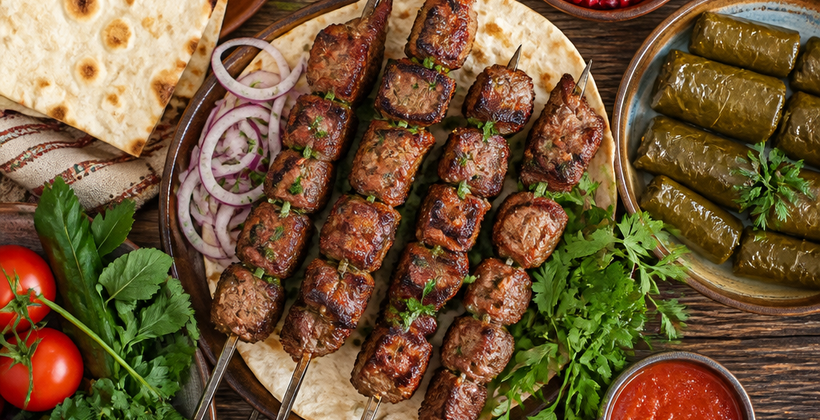
If you've never tasted Armenian food before, you're in for a beautiful introduction. Armenian cuisine is one of the oldest in the world — a culinary tradition shaped by 3,000+ years of farming, fasting, feasting, and trading across the South Caucasus and the wider Middle East. It's hearty, herbaceous, smoky, sour, and grounded in family.
This is a beginner's guide to what Armenian food actually is — the dishes you'll see on every Armenian table, what they taste like, how they're eaten, and why they matter.
What makes Armenian food "Armenian"?
Armenian cuisine sits at the crossroads of the Mediterranean, the Middle East, and the Caucasus. You'll recognize some flavors if you've eaten Lebanese, Greek, Turkish, Persian, or Georgian food — but Armenian dishes have their own identity, shaped by a few core ingredients and techniques:
- Lavash — the thin, paper-like bread that goes with almost every meal.
- Lamb — the traditional centerpiece protein.
- Bulgur and rice — staple grains that show up in pilafs, stuffings, and soups.
- Fresh herbs — parsley, tarragon, cilantro, mint, basil, dill, and "vospi katsil" greens, usually served raw alongside the main dish.
- Yogurt (matsoun) — fermented, slightly sour, used in dips, soups, sauces, and drinks.
- Pomegranate, walnut, apricot — three flavors that show up constantly in sweet and savory dishes alike.
- Charcoal grilling and slow simmering — the two main cooking techniques.
Now let's get to the dishes.
Khorovats (Armenian BBQ)
Khorovats (խորոված) is the national dish — Armenian BBQ. The word literally means "grilled," and at any Armenian gathering, someone is firing up the charcoal for it. The traditional version is chunks of pork (or lamb, or chicken, or sturgeon) marinated overnight in onion and salt, threaded onto long skewers, and grilled over wood embers until the outside is crispy and the inside is juicy.
You can't talk about khorovats without talking about khorovats-bowls of grilled vegetables — whole eggplants, tomatoes, and bell peppers tossed onto the same fire, then peeled and chopped while still hot into a smoky, dressing-less salad.
How it's eaten: wrapped in fresh lavash with raw herbs, pickled vegetables, and a side of yogurt.
Dolma (stuffed grape leaves or vegetables)
Dolma (տոլմա) means "stuffed" in old Turkic — and Armenians have been stuffing things long before anyone called it that. The classic is tender grape leaves wrapped around a filling of ground lamb or beef, rice, herbs (parsley, mint, dill), and warm spices, then simmered until perfectly tender.
There's also pasuts dolma, a Lenten version made with bulgur, lentils, beans, and tomato paste stuffed into pickled cabbage leaves. It's even better than the meat version, and it's traditional Christmas Eve food in many Armenian households.
How it's eaten: with a spoonful of garlic yogurt on top and a piece of lavash to scoop with.
Lavash (the bread that's actually a UNESCO heritage)
Lavash (լավաշ) is so culturally important that UNESCO added it to its list of Intangible Cultural Heritage in 2014. It's a soft, paper-thin flatbread, traditionally baked in a clay oven called a tonir — the baker slaps wet dough against the inside wall, and 30 seconds later it's done.
Lavash is the universal Armenian utensil. You wrap khorovats in it. You wrap herbs and cheese in it for breakfast. You tear it and dip it into soups. You stuff it with leftovers. It's so foundational that the Armenian phrase for "to break bread" really does mean to tear lavash with someone.
Tan (the salty yogurt drink)
Tan (թան) is yogurt thinned with cold water and a pinch of salt — sometimes blended with dried mint or dill. It tastes a little weird the first sip (like... liquid salted yogurt, because it is) and then becomes addictive. Armenians drink it ice-cold with khorovats, with grilled fish, with anything spicy, or just on a hot day to cool down.
It's basically the Armenian Gatorade — refreshing, mildly probiotic, and surprisingly hydrating.
Manti (the tiny dumplings)
Manti (մանթի) are small boat-shaped dumplings — open at the top, filled with spiced ground lamb, packed into a baking dish, and baked until the edges are crispy. They're served swimming in garlic yogurt with a drizzle of paprika butter and sumac.
Western Armenian families (those with roots in Anatolia and Cilicia) consider manti a special-occasion dish — labor-intensive to make, deeply nostalgic to eat. If you're ever invited to an Armenian grandma's house and she serves you manti, you've been adopted.
Harissa (the original slow food)
Harissa (հարիսա) is one of Armenia's most ancient dishes — pre-Christian, possibly Bronze Age. It's a thick porridge of slow-cooked cracked wheat and chicken, stirred for hours until the meat breaks down completely and the texture becomes silky and savory. Topped with a swirl of melted butter and a sprinkle of cumin or paprika.
Note: this is not the spicy North African chili paste of the same name — totally different dish, totally different origin. Armenian harissa is the original.
Lahmajoun (the Armenian flatbread "pizza")
Lahmajoun (լահմաջուն) is a crispy, paper-thin flatbread topped with a wet mixture of spiced minced meat, finely chopped tomatoes, parsley, and onion, baked until the edges curl. People call it "Armenian pizza" but it's really more of a savory crepe.
How it's eaten: with a generous squeeze of fresh lemon, rolled up, and consumed in roughly four bites.
Borek (the flaky cheese pastry)
Borek (բյորեկ) — layers of buttery phyllo wrapped around a filling of feta cheese and parsley, or spinach, or ground beef. Baked until golden and shatteringly crisp. A morning staple at Armenian bakeries, and breakfast for Armenian kids on the way to school for generations.
Gata (the sweet bread)
Gata (գաթա) is the dessert side of Armenian baking — a soft, slightly sweet pastry layered with a crumbly butter-sugar-flour filling called khoriz. Often stamped with a decorative pattern on top before baking. Different regions have different gatas — some are round and large, some are individual hand-pies.
How it's eaten: with strong Armenian coffee, in the afternoon.
Armenian coffee (and why it matters)
Armenian coffee is dark, finely ground, brewed in a small long-handled pot called a jezve with sugar and water, never filtered, and sipped slowly. The thick coffee grounds settle at the bottom — and when you finish, you flip the cup upside down on the saucer, wait for the grounds to dry, and someone (usually the matriarch of the family) "reads" the patterns to tell your fortune.
It's social, ritual, gossip, and dessert all in one tiny cup.
Other dishes worth knowing
- Spas — a warm yogurt soup with wheat berries and herbs. Sounds strange, tastes incredible.
- Khash — slow-simmered cow's foot soup eaten with garlic and lavash. Traditionally a breakfast dish in winter, often accompanied by vodka.
- Ghapama — a whole pumpkin stuffed with rice, dried fruit, and honey, then baked. Made famous by the children's song.
- Aveluk — a dish made from dried mountain sorrel that's been braided and aged. Earthy, slightly sour, very Armenian.
- Basturma — air-cured beef coated in fenugreek paste. Sliced thin, eaten with bread and eggs.
- Soujouk — spiced dry-cured sausage, eaten the same way as basturma.
- Pakhlava — Armenian baklava. Walnut-heavy (not pistachio-heavy), often with cinnamon.
- Sujukh — a sweet treat made by dipping a string of walnuts into thickened grape molasses. Like Armenian fruit leather, but better.
How to actually eat Armenian food
Armenian food is family food. It's meant to be eaten communally, with too many plates on the table, with herbs picked from a bowl by hand, with lavash torn and shared, and with someone insisting you eat one more bite even after you've finished. There's almost always coffee waiting for after the meal, and almost always conversation that lasts longer than the meal itself.
If you want to try real Armenian food in Los Angeles, the city has the largest Armenian community outside Armenia — and dozens of Armenian-owned bakeries, restaurants, and caterers serving the real thing. Browse the Restaurants & Cafes and Catering categories in the SupportArmenian directory to find one near you.
Bari akhorzhag (բարի ախորժակ) — bon appétit.