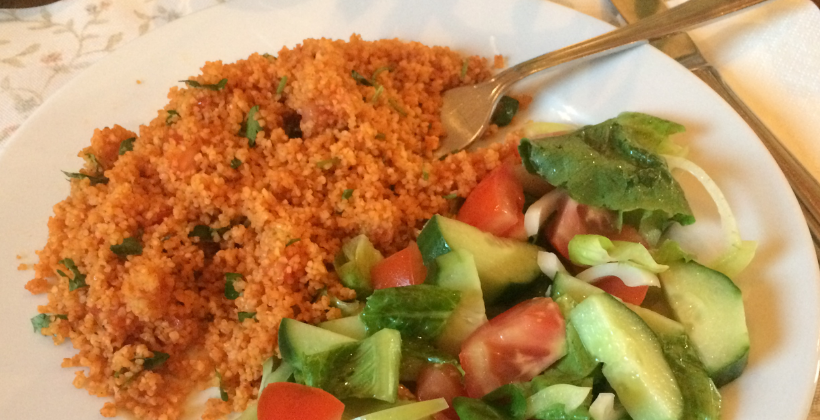
Eetch (or eech) is the Armenian bulgur salad that quietly outshines everything else at the mezze table. While guests fill their plates with dolma and lahmajoun, it's always the big bowl of eetch that runs out first. It has that quality: it tastes light, but one scoop becomes three.
Often compared to Lebanese tabbouleh, eetch is distinctly its own thing. Where tabbouleh is parsley-forward and uses fresh tomatoes, eetch is bulgur-forward with a rich tomato paste base, generous lemon, and a generous pour of olive oil. The result is a salad that's earthy, tangy, herby, and deeply satisfying — and it comes together in well under an hour with no real cooking required, just soaking.
What Is Eetch, Exactly?
Eetch is an Armenian grain salad made with fine bulgur that's softened in tomato-enriched water rather than cooked on the stove. The bulgur absorbs the liquid as it sits, becoming tender and fluffy while soaking up the tomato paste, lemon juice, and olive oil. Fresh herbs — mainly flat-leaf parsley and green onions — are folded in at the end along with a squeeze of lemon, and the salad is served at room temperature or slightly chilled.
It's a fixture at Armenian gatherings, holiday tables, and family barbecues. You'll find it next to lahmajoun, alongside hummus, or as a side to grilled khorovats. Armenians also eat it on its own for a light lunch, scooped into romaine lettuce leaves. It keeps well in the fridge and — like most grain salads — actually tastes better the next day once the flavors have had time to deepen.
"Every Armenian household has a slightly different eetch. Some add walnuts, some skip the parsley, some use hot red pepper flakes. There's no wrong version — just the one your family makes."
Ingredients
- 2 cups fine bulgur (also called #1 bulgur or extra-fine bulgur)
- 2 cups boiling water
- 3 tablespoons tomato paste
- 1 tablespoon red pepper paste (biber salçası) — optional but traditional
- ⅓ cup extra-virgin olive oil, plus more for drizzling
- Juice of 1½–2 lemons (about ¼ cup), plus more to taste
- 1 teaspoon salt, plus more to taste
- ½ teaspoon cumin
- ½ teaspoon Aleppo pepper or red pepper flakes, adjust to taste
- 1 bunch flat-leaf parsley, finely chopped (about 1½ cups packed)
- 6–8 green onions (scallions), thinly sliced, green and white parts
- Small bunch fresh mint, finely chopped (optional — some families use it, some don't)
- 1 large ripe tomato, finely diced (optional, for a fresher version)
- ½ cup walnuts, roughly chopped (optional, for crunch)
- 1 cucumber, finely diced (optional)
- Romaine lettuce leaves and lemon wedges, for serving
Bulgur tip: make sure you're using fine bulgur (#1), not coarse or medium. Fine bulgur softens and absorbs liquid without any cooking — it just needs boiling water and time. Coarse bulgur needs to actually be cooked and won't give you the right texture for eetch.
Instructions
- Make the tomato broth. Bring 2 cups of water to a boil. In a large mixing bowl, whisk together the tomato paste, red pepper paste (if using), olive oil, lemon juice, salt, cumin, and Aleppo pepper. Pour the boiling water into the bowl and stir until the tomato paste is fully dissolved. Taste it now — it should be well-seasoned, slightly tangy, and a touch spicy, since the bulgur will absorb a lot of that flavor as it sits.
- Add the bulgur. Pour the fine bulgur into the hot tomato broth and stir well so every grain is coated. The liquid should just barely cover the bulgur, with maybe an eighth-inch showing on top. Cover the bowl tightly with plastic wrap or a plate.
- Let it rest, undisturbed. Let the covered bowl sit at room temperature for 20–30 minutes without stirring. The bulgur will absorb all the liquid and become tender. Check at the 20-minute mark by tasting a few grains — if there's still a hard, chalky center, re-cover and give it another 5–10 minutes.
- Fluff with a fork. Once the bulgur is tender, uncover the bowl and use a fork — not a spoon — to fluff it with light, lifting strokes, the same way you'd fluff rice. This separates the grains instead of mashing them into a paste.
- Cool to room temperature. Let the fluffed bulgur sit for about 15 minutes to cool down before adding the herbs — folding fresh herbs into hot grain wilts them and dulls the color. Spreading the bulgur out on a sheet pan speeds this up if you're short on time.
- Fold in the herbs and vegetables. Once cooled, fold in the chopped parsley, green onions, mint (if using), diced tomato or cucumber (if using), and the walnuts (if using). Use a gentle folding motion rather than stirring hard, so the bulgur stays fluffy rather than compacting.
- Taste and adjust. This is the step most people skip and shouldn't. Taste the eetch and adjust boldly — more lemon for brightness, more olive oil for richness, more salt or Aleppo pepper for a kick. It should taste vibrant and a little assertive, not muted.
- Rest again, then serve. Let the finished eetch sit for at least 15 minutes before serving so the herbs settle into the grain. Transfer to a serving bowl, drizzle a generous swirl of olive oil over the top, and garnish with extra parsley and lemon wedges. Serve with romaine leaves on the side for scooping, or alongside warm flatbread.
Make-ahead tip: eetch keeps covered in the fridge for up to 3 days and the flavor actually improves overnight. If it thickens up in the fridge, stir in a little fresh lemon juice and olive oil before serving to loosen it back up.
The Secret to Great Eetch
The two things that separate a memorable eetch from a forgettable one are the quality of the tomato paste and the amount of lemon. Use a good, dark, concentrated tomato paste — ideally from an Armenian or Middle Eastern grocery store. And use fresh lemons, not bottled juice. The brightness of real lemon is what makes eetch pop. Most people don't add enough.
The second secret is the olive oil. Don't measure it too carefully — pour generously. Eetch is not a diet dish. The olive oil carries the flavors and gives the salad a rich, glossy finish that makes it irresistible. A drizzle at the very end, just before serving, makes a visible difference.
Eetch vs. Tabbouleh: What's the Difference?
Both are bulgur salads from the same regional culinary tradition, but they're distinct dishes. Tabbouleh (known in Armenian as tabouli) is heavily parsley-based — the parsley is the main ingredient, and the bulgur is almost secondary. It uses fresh tomatoes, lots of mint, and a simple olive oil and lemon dressing with no tomato paste.
Eetch is bulgur-first. The grain is the star, seasoned with tomato paste (and sometimes red pepper paste), and the herbs are supporting players. It tends to be richer and more filling than tabbouleh, with a deeper, earthier flavor. Some Armenian families make both and serve them side by side. They're not competing — they're complementary.
Interestingly, the SupportArmenian blog also has a separate Armenian tabbouleh recipe if you want to compare them and make both for your next gathering.
How Armenians Serve Eetch
Eetch shows up everywhere in Armenian food culture. You'll find it at:
- Mezze spreads — next to hummus, muhammara, mutabal, and olives
- Barbecues (khorovats) — as a light side alongside the grilled meats
- Holiday dinners — Easter, Christmas, New Year's
- Potluck parties — because it travels well and makes a lot
- Simple weekday lunches — scooped into romaine leaves with a piece of string cheese
The romaine scooping tradition is worth trying if you haven't. Tear off a leaf of crisp romaine, load it with a spoonful of eetch, and eat it like a taco. The crunch of the lettuce against the tender, herby bulgur is one of those simple combinations that just works.
Tips, Swaps & Variations
Vegan & Gluten-Free Notes
Eetch is naturally vegan — no animal products needed. It is not gluten-free since bulgur is made from wheat. If you need a gluten-free version, some people substitute fine-grain cauliflower rice or cooked millet, though the texture will be different. Genuine eetch is a wheat dish.
Add Walnuts for Texture
Fold in ½ cup of roughly chopped walnuts just before serving. The nutty crunch against the soft bulgur is a great contrast, and walnuts are deeply embedded in Armenian cooking generally. Toasted walnuts are even better.
Make It Spicier
Double the Aleppo pepper, or add a finely diced green chili to the herb fold-in. Some older Armenian recipes call for a significant amount of red pepper paste — don't be afraid of it.
The No-Herb Version
Some Armenians grew up with a very simple eetch that's just bulgur, tomato paste, olive oil, and lemon with only green onions — no parsley, no mint. It's more of a plain grain pilaf-style dish. This version is great as a starchy side alongside meat dishes and is how many Glendale lunch plates are served.
Where to Find the Ingredients
Fine bulgur and quality tomato paste are easy to find at any Armenian or Middle Eastern grocery store. In the Los Angeles area, you can find everything you need at stores like Super King, Jon's, Ararat Market, or any of the Armenian delis in Glendale. Red pepper paste (biber salçası) is usually in the same aisle as the tomato paste or near the international condiments section.
You can also browse the Armenian-owned grocery and deli markets on SupportArmenian to find a store near you that carries authentic ingredients.
Eetch is one of those recipes that's easy to make once but impossible to stop making. It's the kind of dish that brings a bowl to a party and comes back empty, with three people asking for the recipe. Now you have it. Make it for your family, bring it to your next kef, and add it to your regular weeknight rotation. Your tatik would approve.