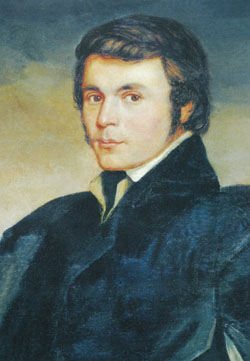
Who Was Khachatur Abovyan?
Khachatur Abovyan was born on October 15, 1809, in the village of Kanaker, near Yerevan, into an old Armenian family. He is remembered as the father of modern Armenian literature — the writer who broke with centuries of tradition by writing not in classical Armenian (grabar), which ordinary people could no longer understand, but in the living, spoken language of the Armenian people. That single decision reshaped Armenian letters forever.
Educated first at the Etchmiadzin monastery and later at the Nersisyan School in Tiflis, Abovyan's life changed in 1829 when he joined the Baltic German explorer Friedrich Parrot as translator and guide on the first recorded ascent of Mount Ararat. Parrot was so impressed with the young Armenian that he arranged a scholarship for him at the University of Dorpat (today Tartu, Estonia), where Abovyan absorbed European ideas about education, language, and national awakening.
Returning home, he devoted himself to teaching — serving as a school supervisor in Tiflis and later Yerevan, opening his own school, writing textbooks, and fighting tirelessly against the conservatism of his era, which viewed his vernacular language and modern teaching methods with suspicion.
His novel gave the Armenian people something they had not had in centuries: a literature written in their own living voice.
— On the legacy of Wounds of Armenia
Wounds of Armenia
Written in 1841 and published posthumously in 1858, Wounds of Armenia (Verk Hayastani) is the first novel written in modern Eastern Armenian. Set during the Russo-Persian War of 1826-1828, it follows the hero Aghasi in the struggle against Persian rule, weaving folklore, patriotism, and the everyday speech of Armenian villagers into a national epic. It became a cornerstone of the Armenian national awakening in the 19th century.
By choosing the vernacular, Abovyan made literature accessible to ordinary Armenians for the first time in centuries — an act as political as it was literary. Nearly every major Armenian writer who followed stands in his debt.
Major Works & Milestones
Wounds of Armenia
Written 1841 · Published 1858
The first modern Armenian novel, written in the spoken language of the people. A foundational text of Armenian national literature.
First Ascent of Mount Ararat
1829
Accompanied Friedrich Parrot to the summit of Ararat — the first recorded ascent of Armenia's sacred mountain.
Nakhashavigh
1838
A pioneering primer for teaching children in modern Armenian, reflecting his lifelong devotion to accessible education.
Fables, Poems & Translations
1830s–1840s
A wide body of fables, verse, ethnographic writing, and translations of European authors into Armenian.
The Mystery of His Disappearance
On the morning of April 14, 1848, Abovyan left his home in Yerevan for a walk — and was never seen again. No trace of him was ever found, and his fate remains one of the great mysteries of Armenian history. He was 38 years old. Theories have ranged from accident to foul play, but none has ever been proven.
His disappearance transformed him into a legend: the vanished author of the nation's first novel became part of the Armenian story itself — a voice interrupted, yet impossible to silence.
Legacy
Abovyan's name is everywhere in Armenian life: the city of Abovyan near Yerevan, the Armenian State Pedagogical University, and streets and schools across Armenia and the diaspora carry it. His house in Kanaker is a museum, and Wounds of Armenia remains required reading for every Armenian student.
More than any monument, his true legacy is the modern Armenian literary language itself — every novel, poem, and newspaper written the way Armenians actually speak traces back to his courage to write the way his people talked.
Sources
More Notable Armenians