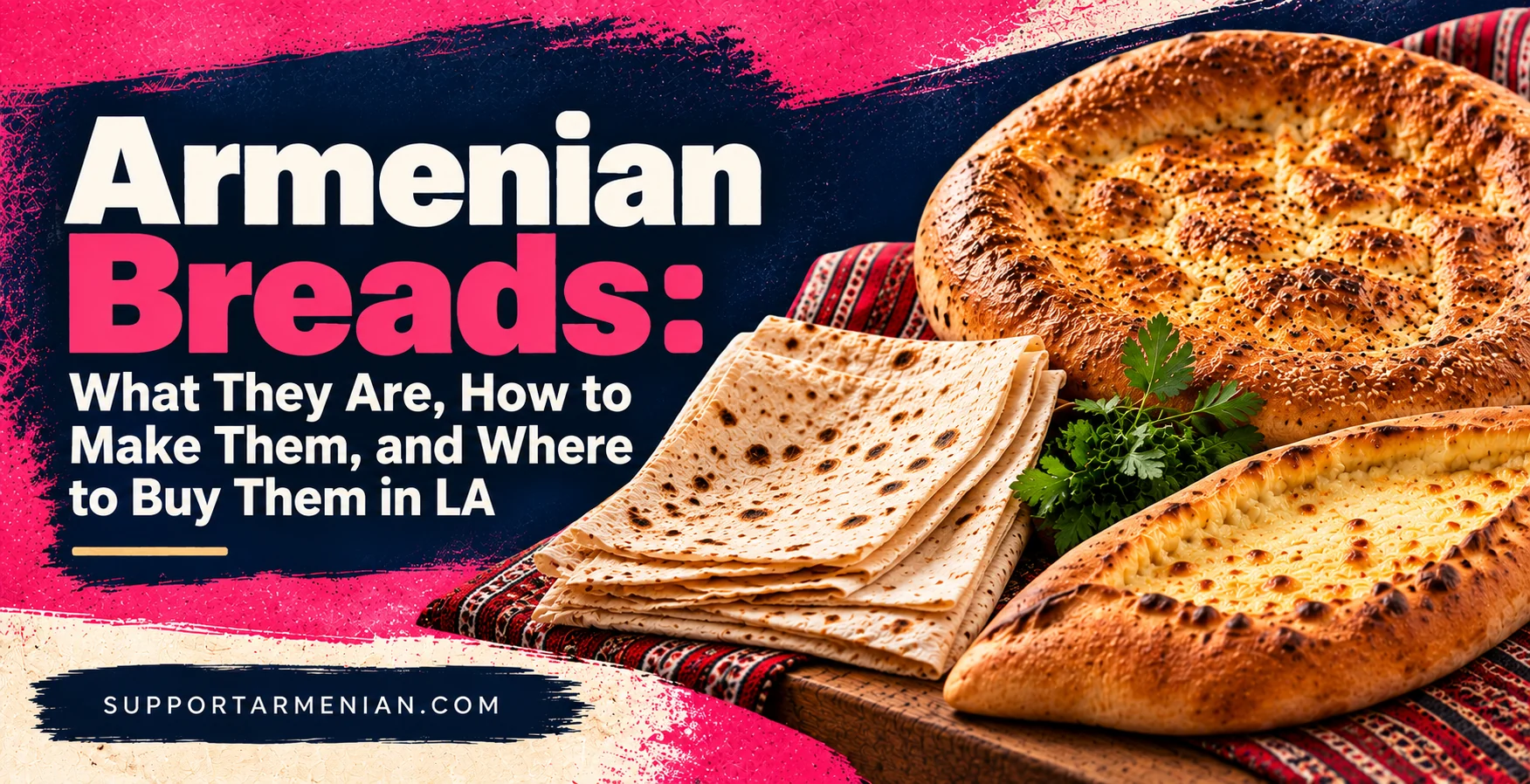
Bread is at the center of every Armenian meal. It is not a side dish. Lavash is used as a plate, a wrap, and a spoon, and it sits on the table whether the meal is a weekday dinner or a wedding feast.
This is a guide to the breads worth knowing: what they are, where they came from, how they are made, how to get close at home without a clay oven in your backyard, and which bakeries in Los Angeles to buy them from when you would rather not. At the end, two Persian breads that are not Armenian at all but live in half the Glendale kitchens.
First, the tonir
Almost every bread below makes sense once you understand the oven. A tonir is a clay oven sunk into the ground, fired with wood, and heated until the walls hold the kind of temperature a home oven never reaches. The baker leans over the mouth and slaps the dough directly onto the inner wall, where it sticks, bakes in under a minute, and is peeled off with a hook.
It was never just equipment. The tonir sat at the center of the house, it heated the room, and in some villages a new one is still blessed by a priest before anything is baked in it. When you taste the char on good lavash and cannot reproduce it at home, the oven is the reason.
Lavash: the one everybody means
The most popular Armenian bread is lavash. It is paper-thin, soft, foldable, and served at almost every meal.
The dough is simple: wheat flour, water, and salt. The skill is in the rolling and baking. It is kneaded, divided, rolled out thin, then stretched over a padded oval cushion until it is almost translucent. The baker reaches into the tonir and presses the cushion against the wall. Thirty seconds to a minute later the bread is lifted out, blistered brown in patches. Those blisters have a name, bshtiks, and they are how you tell real tonir lavash from a factory sheet.
In 2014 UNESCO inscribed it on the Representative List of the Intangible Cultural Heritage of Humanity as "Lavash, the preparation, meaning and appearance of traditional bread as an expression of culture in Armenia." The listing is not really about flour and water. It is about who does it: small groups of women baking together, girls taking on more of the work as they get older, men building the ovens and making the cushions and passing that on separately. The 2014 listing is specifically Armenian.
Lavash also keeps well, which makes it practical. Baked in quantity, stacked, and dried, it will hold for up to six months. Sprinkle water between the sheets, cover with a towel, wait twenty minutes, and it comes back soft. Stale lavash does not get thrown out either, it becomes panrkhash, torn up and baked with cheese and butter into something between a casserole and a gratin.
And it shows up where food usually does not. At Armenian weddings, lavash is laid over the shoulders of the bride and groom as a blessing for fertility and prosperity, which is covered in more detail in our guide to Armenian wedding traditions.
Where lavash actually comes from
The origin of lavash is disputed, and no one can say for certain where it started. Armenia, Azerbaijan, Georgia, Turkey and Iran all claim it, and the scholarship does not settle it. Even the etymology is open: the most widely held theory routes the word through Persian, with one linguist tracing that Persian word back to an Aramaic root meaning "to knead," while the Armenian linguist Hrach Martirosyan tentatively links the Armenian word to a Proto-Armenian root meaning "flat." The oldest dated text anyone points to that uses the term is from 1451.
The UNESCO listing tells the same story. Armenia's nomination originally called it Armenian bread. Other countries objected, the committee changed the wording to "as an expression of culture in Armenia," and the inscription itself acknowledges that lavash is shared across the region. Two years later a separate nomination from Azerbaijan, Iran, Kazakhstan, Kyrgyzstan and Turkey was inscribed as "flatbread making and sharing culture: Lavash, Katyrma, Jupka, Yufka."
What is not in dispute is how deep it runs in Armenia specifically. There is an old story about King Arame of Urartu, held captive by the Assyrians, who is slipped lavash hidden in his armor. A folk tale does not prove a start date, but it shows how long Armenians have considered this bread their own.
How to make lavash at home
Most of us do not have a tonir. The closest you get is a dry cast-iron pan on high heat or a pizza steel in a very hot oven.
- Mix 3 cups flour, 1 cup warm water, 1 teaspoon salt and, if you want a softer bread, 1 teaspoon yeast (traditional lavash is barely leavened or unleavened, so skipping it is fine). Knead until smooth, about 8 minutes, then rest covered for an hour.
- Divide into 8 balls. Roll each one as thin as you physically can, thinner than you think is reasonable, until you can nearly see through it. Flour generously or it will stick to itself.
- Heat a cast-iron skillet dry over high heat until a drop of water skips. Lay the sheet in. It will puff and blister in 30 to 45 seconds. Flip, give it another 20 seconds, and pull it.
- Stack the finished sheets under a clean towel so the steam keeps them pliable.
Eat them the same day soft, or dry them out deliberately and revive them later with water. Both are correct.
Matnakash: the everyday loaf
If lavash is the bread served at the table, matnakash is the everyday loaf at home. A soft, thick, golden oval loaf with a glossy top and long grooves pressed into the surface, somewhere between focaccia and a good sandwich bread.
The name is literal. Matnakash means "drawn by fingers," after the lines the baker draws across the dough before it goes in the oven. It is also the youngest bread on this list by a wide margin. Matnakash is a Soviet-era loaf, first made at scale in state bakeries, and it became Armenia's everyday bread in the twentieth century. It is newer than lavash, but it has stayed popular ever since.
How to make matnakash at home
This is the one you can genuinely nail in a normal oven, and the one to start with.
- Make a soft dough: 4 cups flour, 1.5 cups warm water, 2 teaspoons yeast, 2 teaspoons sugar, 1.5 teaspoons salt. Knead 10 minutes, rise until doubled.
- Shape into a flat oval about an inch thick on a parchment-lined tray. Let it rise again for 30 minutes.
- Make the glaze that gives it the shine: whisk 1 tablespoon flour into half a cup of water, bring to a simmer until it thickens slightly, cool, and brush it over the whole surface.
- With wet fingers, draw the lines: one long oval border inside the edge, then three or four lines down the middle. Press firmly, you want real channels, not scratches.
- Bake at 450F for 20 to 25 minutes until deep golden.
The rest of the family
Armenian baking does not stop at two breads. Each of these has its own full recipe on the site.
- Jingalov hats. From Artsakh, and still the bread most tied to one place. A flatbread stuffed with as many as twenty different wild greens and herbs, folded shut and cooked on a dry griddle. The herbs were foraged seasonally, which is why the filling changes through the spring and why no two cooks make it identically.
- Lahmajoun. Thin rounds spread with minced meat, tomato, pepper, onion and parsley, baked hot and fast. Squeeze lemon, roll, eat. The name is Arabic, lahm bi-ajin, "meat with dough," and the earliest written recipe anyone has found sits in a thirteenth-century cookbook from Aleppo. It is a Levantine dish that Armenians of the Ottoman south carried with them everywhere they went, and it only reached Armenia itself in the 1960s, brought to Yerevan by repatriates from Aleppo.
- Choreg. Braided, lightly sweet, scented with mahleb and nigella. Easter bread, though nobody waits for Easter. Some families bake a coin into the loaf and whoever gets that slice takes the luck. In her memoir, Fethiye Cetin describes a special bread her grandmother's village made every spring, and she only realized it was choreg after learning her grandmother was Armenian.
- Gata. Sweet bread layered with a buttery flour-and-sugar filling called khoriz, scored on top in patterns that vary by region, which is the point: the pattern tells you where the baker is from. The version sold outside Geghard monastery is its own institution.
- Cheese boreg. Phyllo layered with cheese and herbs, baked until the top shatters.
- Ajarski khachapuri. Georgian by origin, from Adjara on the Black Sea, and thoroughly adopted. A boat of dough filled with cheese and finished with an egg.
- Tonir hats. Lightly leavened charred rounds about the size of a small hubcap, chewy like good pizza dough, sturdy enough to build a serious sandwich on.
Where to buy Armenian bread and lavash in Los Angeles and Glendale
Los Angeles is one of the few places outside Armenia where you can buy fresh lavash, matnakash, choreg and gata on the same afternoon. A starting list from our directory:
- Sasoun Bakery in Glendale, and the Santa Monica Blvd location in Little Armenia.
- Masis on East Alameda in Burbank.
- Berolina Bakery on Honolulu Avenue in Montrose.
- Movses Pastry Bakery on West Glenoaks in Glendale.
- Papillon International Bakery in North Hollywood.
- Victory Bread in the Valley.
- Yerord Mas Bakery & Deli on San Fernando Road.
- Paradise Pastry & Cafe on West Glenoaks.
- Anush Bakery & Market in Valley Glen.
For a longer list with hours and what each one is actually good at, see the best Armenian bakeries in Glendale, or browse the full Bakeries & Cakes category.
Honorable mention: the Persian breads in Armenian kitchens
Neither of these is Armenian. Both are staples in Armenian households across Glendale and the Valley, especially among Iranian-Armenians, and a bread guide for this area would be incomplete without them.
Sangak
The national bread of Iran, and the more dramatic of the two. Sangak means "little pebble," which is exactly how it is baked: on a bed of hot river stones. The dough is a wet whole-wheat sourdough, too slack to handle normally, so the baker spreads it along an oiled metal peel with a handle that can run close to ten feet, then stretches it onto the stones. That stretch is what gives sangak its ridged surface, thick chewy ribs alternating with thin crisp edges. It comes out as a long triangle, gets knocked against a metal mesh to shake off any stuck pebbles, and is often hung on the bakery wall to cool. It was reportedly the bread of the Persian army, first recorded in the 11th century, with soldiers each carrying a few pebbles so an oven could be built at camp.
Barbari
Thicker, softer, and the more everyday of the two. Barbari is a long oval loaf, commonly 70 to 80 cm end to end, brushed before baking with a cooked flour-and-water glaze that turns the top skin glossy and faintly pretzel-like in the oven. Usually finished with sesame or black caraway seeds. The name traces to the Barbars, and in Iran it is typically eaten warm with Lighvan, a sheep's milk cheese in the feta family.
Armenian bread FAQ: lavash, matnakash, and more
What is the most popular Armenian bread?
Lavash, without serious competition. It is the thin flatbread served at nearly every Armenian meal and the one UNESCO recognized in 2014.
Where does lavash come from?
There is no settled answer. Armenia, Azerbaijan, Georgia, Turkey and Iran all claim it, and the word's etymology is unresolved. UNESCO inscribed Armenia's lavash tradition in 2014 and a separate shared flatbread tradition from five other countries in 2016.
What is the difference between lavash and pita?
Pita is leavened and puffs into a pocket. Lavash is barely leavened or unleavened, rolled far thinner, and stays flat and pliable. Lavash wraps, pita holds.
How long does lavash last?
Fresh and soft, a day or two. Dried deliberately and stacked, up to six months. Sprinkle water between the sheets, cover with a towel, and wait about twenty minutes to bring it back.
What does matnakash mean?
"Drawn by fingers," for the grooves the baker presses into the top of the loaf before baking.
Are sangak and barbari Armenian?
No, both are Iranian. They are included here because they are staples in Iranian-Armenian households and easy to find in Glendale and the Valley.
Can you make lavash without a tonir?
Yes, though it will not be identical. A dry cast-iron skillet on high heat or a pizza steel in a very hot oven gets you most of the way, including the blisters.
Where can I buy fresh lavash in Los Angeles?
Several Armenian bakeries in Glendale, Burbank, Montrose, North Hollywood, and Little Armenia sell fresh lavash and matnakash daily, including Sasoun Bakery, Masis, Berolina Bakery, and Movses Pastry Bakery. Go early for the freshest bread.
What is tonir bread?
Tonir bread is any bread baked in a tonir, the traditional Armenian clay oven. Lavash is baked on the oven wall, while tonir hats is a thicker round loaf baked there too. The tonir gives the bread its char and flavor.
What is the best Armenian bakery in Glendale?
Glendale has many Armenian bakeries, including Sasoun Bakery, Movses Pastry Bakery, and Paradise Pastry & Cafe. Each is known for something different, so see our guide to the best Armenian bakeries in Glendale to compare them.
How do you make matnakash at home?
Make a soft yeast dough, shape it into a flat oval, brush it with a cooked flour-and-water glaze, press long grooves into the top with wet fingers, and bake at 450F for 20 to 25 minutes until deep golden.
🇦🇲 Find Armenian-Owned Businesses Near You
Browse the most comprehensive Armenian business directory in Southern California.