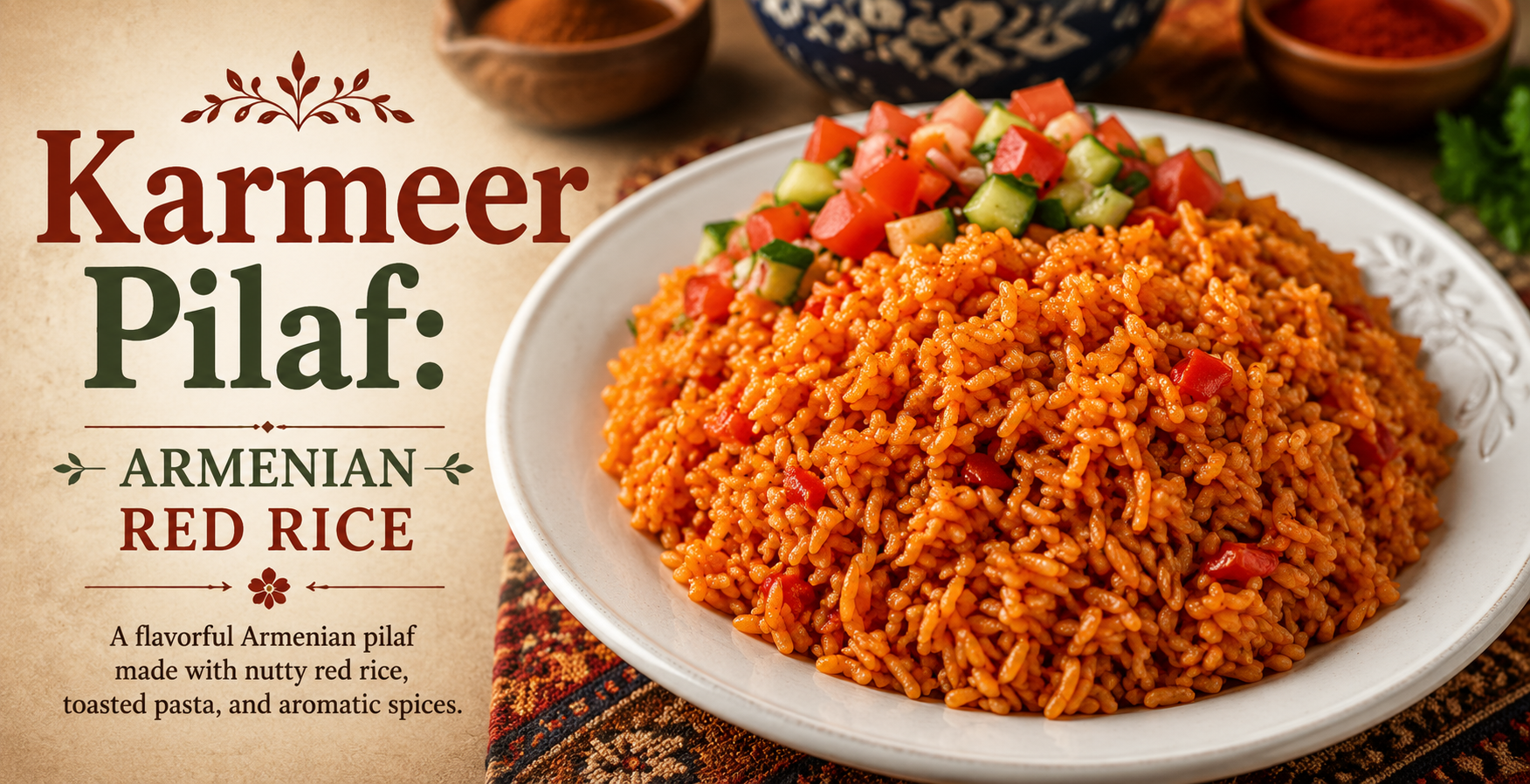
If you have ever sat down at an Armenian table and seen rice that was the color of a sunset, that was karmir pilaf. Karmir means red in Armenian, and this dish earns its name from a generous spoonful of tomato paste cooked directly into butter before the rice ever touches the pot. The result is rice that is deep, savory, and faintly tangy, with a color that turns every plate it sits on into something that looks like it took a lot more effort than it actually did.
Karmir pilaf is not a complicated dish, but it is one that requires you to pay attention at the right moments. Get the tomato paste into the butter at the right heat, let it cook until it darkens and loses its raw edge, and what follows is almost automatic. The rice absorbs the tomato-butter base as it cooks, picking up the color and flavor evenly throughout every grain.
It is a natural companion to khorovats and kyufta, and it holds its own against any braise or stew where the sauce deserves something more interesting than plain white rice to soak into. Once you make it, you will wonder why you did not have it in your rotation years ago.
Ingredients (Serves 4 to 6)
- 1.5 cups long-grain white rice (basmati preferred)
- 1/2 cup thin vermicelli noodles, broken into 1-inch pieces
- 3 tablespoons unsalted butter
- 2 tablespoons tomato paste
- 2.5 cups low-sodium chicken broth
- 1/2 teaspoon salt
- 1/4 teaspoon black pepper
- Optional: pinch of Aleppo pepper for mild warmth
How to Make Karmir Pilaf: Step-by-Step
Step 1: Rinse the rice
Place the rice in a fine-mesh strainer and rinse under cold water, stirring with your hand, until the water runs mostly clear. This removes surface starch and prevents the grains from clumping. Drain well and set aside.
Step 2: Toast the vermicelli
Melt the butter in a medium heavy-bottomed saucepan over medium heat. Add the broken vermicelli and stir to coat in the butter. Cook, stirring frequently, for 3 to 4 minutes until the noodles turn a deep golden brown. Watch them closely as they go quickly from golden to burned.
Step 3: Cook the tomato paste
Add the tomato paste directly to the pot with the toasted vermicelli. Stir constantly and cook for 1 to 2 minutes until the paste darkens slightly and smells sweet and concentrated rather than raw. This step is important: raw tomato paste has a sharp, almost metallic edge. Cooking it in the butter for a minute or two removes that and replaces it with a deep, slightly caramelized tomato flavor. If using Aleppo pepper, add it now.
Step 4: Add the rice
Add the rinsed and drained rice to the pot. Stir to coat every grain in the tomato-butter mixture. Cook for 1 to 2 minutes, letting the rice toast lightly and pick up the color evenly.
Step 5: Add warm broth
Warm the chicken broth in a separate small saucepan or the microwave until hot. Pour the warm broth over the rice. Add salt and black pepper. Stir once to combine. Bring to a boil over medium-high heat, then reduce to the lowest setting, cover with a tight-fitting lid, and cook for 18 minutes. Do not lift the lid.
Step 6: Rest and fluff
After 18 minutes, remove the pot from the heat. Slide a folded paper towel under the lid to absorb condensation, replace the lid, and let the pilaf rest off the heat for 10 minutes. Then remove the lid and fluff gently with a fork. The rice should be a deep brick red, each grain separate, with the vermicelli visible throughout.
What Makes Karmir Pilaf Different from Regular Pilaf
Both regular Armenian pilaf and karmir pilaf share the same foundation: butter, toasted vermicelli, and broth. The tomato paste is the only addition, but it changes the dish significantly. The flavor shifts from clean and buttery to deeper and slightly tangy. The color transforms the presentation entirely. And the aroma while it cooks takes on a savory, almost braised quality that regular pilaf does not have.
Some cooks add a small amount of diced onion, sauteed in the butter before the vermicelli, for extra sweetness and depth. Others add a finely diced tomato along with the paste. Both are valid variations, though the core version with just paste is what you will find at most Armenian tables.
What to Serve with Karmir Pilaf
Karmir pilaf is at its best alongside grilled and roasted meats. It is the natural partner for khorovats, where the smoky char of the meat contrasts beautifully with the bright tomato rice. It works equally well under kyufta, where the poaching liquid from the meatballs can be spooned over the top. Stuffed peppers, lamb shanks, and any slow-braised dish all make excellent companions.
Serve with a spoonful of matzoon or plain yogurt on the side. The coolness and acidity of the yogurt against the warm, rich rice is a classic combination in Armenian cooking.
Tips for Perfect Karmir Pilaf
- Cook the tomato paste until it darkens. One minute in the butter is the minimum. Two minutes is better. You will see it shift from bright red-orange to a deeper brick red, and the smell will change from sharp to sweet. That is when it is ready.
- Use warm broth. Cold broth added to a hot pan drops the temperature unevenly and extends cooking time. Warm broth keeps the process consistent.
- Do not lift the lid. Every time you check, steam escapes. The steam is what cooks the top layer of rice.
- The towel trick matters. The paper towel absorbs condensation inside the lid. Without it, water drips back onto the rice and makes the top layer soggy.
- Taste your broth before adding salt. Different brands vary widely in sodium content. Low-sodium broth usually needs a full half-teaspoon of salt; regular broth may need less.
Frequently Asked Questions
What does karmir mean in Armenian?
Karmir (կարմիր) means red. Karmir pilaf simply means red pilaf, named for the color the tomato paste gives the rice.
What is the difference between karmir pilaf and regular Armenian pilaf?
Regular Armenian pilaf uses butter, vermicelli, and chicken broth for a golden, nutty flavor. Karmir pilaf adds tomato paste cooked into the butter first, giving the dish a deep red color and a slightly richer, tangier taste. Same core method, one important addition.
Can I use tomato sauce instead of tomato paste?
Tomato paste is strongly preferred. It is concentrated and cooks into the butter without adding excess water. If you use tomato sauce, reduce the broth by about 1/4 cup to compensate for the extra liquid, or the rice will turn out wet.
Is karmir pilaf spicy?
No. Traditional karmir pilaf is savory and slightly tangy but not spicy. Some cooks add a pinch of Aleppo pepper for very mild warmth, but this is optional.
What do you serve with karmir pilaf?
It pairs best with grilled meats like khorovats, kyufta, and lamb chops. A dollop of matzoon or plain yogurt on the side is a classic Armenian accompaniment that balances the richness of the rice.
Karmir pilaf is proof that one tablespoon of tomato paste at the right moment can completely transform a dish you already know. Make it once alongside your next batch of khorovats and it will earn a permanent place on your table. Browse more Armenian recipes in our full recipe collection.