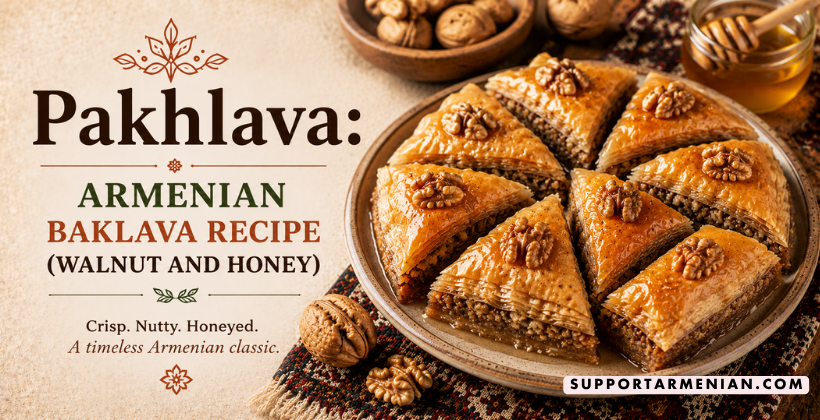
Pakhlava is the Armenian version of baklava, and if you have ever had both, you know the difference is real. Where Greek baklava leans sweet and Turkish versions often use pistachios, Armenian pakhlava is built on walnuts, layered more generously, and soaked in a honey-based syrup that carries rose water and a hint of cardamom. The result is rich and fragrant without being cloying.
In Armenian households, pakhlava appears at Easter, Christmas, New Year, and at every table spread that needs to say "celebration." It is made in large batches, cut into diamond shapes, and given to neighbors and family. Alongside gata and choreg, pakhlava is one of the three pillars of Armenian holiday sweets.
Pakhlava vs. Baklava: What's Different?
The distinctions are subtle but meaningful. Armenian pakhlava typically uses walnuts (not pistachios), incorporates rose water in the syrup, uses honey as the primary sweetener rather than sugar syrup alone, and tends to have a higher ratio of nut filling relative to phyllo layers. The phyllo itself is also brushed more generously with clarified butter, which gives it a deeper crunch and a longer shelf life.
Ingredients
For the pakhlava
- 1 package (1 lb / 450g) frozen phyllo dough, thawed overnight in the refrigerator
- 1 cup (2 sticks / 225g) unsalted butter, melted and clarified
- 2.5 cups walnuts, finely chopped (not ground — texture is important)
- 1 teaspoon cinnamon
- 1/4 teaspoon ground cardamom
- Pinch of ground cloves
- Whole cloves for decoration (optional, pressed into center of each diamond)
For the honey syrup
- 1 cup good-quality honey
- 1/2 cup water
- 1/2 cup sugar
- 1 tablespoon rose water
- 1 teaspoon fresh lemon juice
Instructions
- Clarify the butter. Melt the butter in a small saucepan over low heat. Skim the white foam from the surface and discard. The clear yellow liquid underneath is clarified butter. It holds up better under heat and keeps the phyllo crispier longer than whole butter.
- Prepare the walnut filling. Finely chop the walnuts by hand or in a food processor (pulse briefly, do not grind to powder — you want small pieces with some texture). Mix with cinnamon, cardamom, and cloves. Set aside.
- Set up your station. Preheat oven to 325F (165C). Brush a 9x13 inch baking pan with clarified butter. Lay out the phyllo stack and cover it with a slightly damp kitchen towel to prevent drying while you work.
- Layer the base. Place one sheet of phyllo in the pan and brush generously with clarified butter. Repeat with 7 more sheets, buttering each one, for a total of 8 base layers.
- Add the first filling layer. Spread half the walnut mixture evenly over the phyllo base.
- Add middle layers. Layer 4–6 more phyllo sheets on top of the filling, buttering each one. Spread the remaining walnut mixture evenly.
- Add the top layers. Layer the remaining phyllo sheets on top, buttering each one. Finish with a generous brush of clarified butter on the very top sheet.
- Cut before baking. This step is essential. Using a sharp knife, cut the pakhlava all the way through to the bottom of the pan in a diamond pattern: make parallel cuts diagonally across the pan, then a second set of parallel cuts at an angle to create diamond shapes. If you have whole cloves, press one into the center of each diamond. The cuts must go all the way through — if they do not, the pieces will not separate cleanly after baking.
- Bake. Bake at 325F for 45–55 minutes until the top is deep golden and the edges are crisp. Do not underbake — pale pakhlava will not have the right texture.
- Make the syrup while it bakes. Combine honey, water, and sugar in a small saucepan. Bring to a boil, stirring to dissolve the sugar, then reduce heat and simmer 10 minutes until slightly thickened. Remove from heat and stir in rose water and lemon juice. Keep warm.
- Pour the syrup immediately. As soon as the pakhlava comes out of the oven, pour the hot syrup evenly over the entire surface. Listen for the sizzle. The syrup must be hot and the pakhlava must be hot — this is how the syrup penetrates every layer. Let sit uncovered at room temperature for at least 4 hours, ideally overnight, before serving.
Tips for the Best Pakhlava
The most common mistake is adding cold syrup to hot pakhlava or vice versa. Both must be at the same temperature (both hot) at the moment of combining, or the syrup will sit on top rather than soaking in. The second most common mistake is underbaking — pale phyllo stays soft and chewy instead of crisping up.
Keep phyllo covered with a damp (not wet) towel while working. A dry sheet tears and crumbles. Work quickly and do not second-guess your layers — minor imperfections disappear under the syrup.
The secret to pakhlava that keeps for two weeks is clarified butter and patience. Pour the syrup over both while hot, then walk away. Do not touch it for at least four hours.
What to Pair with Pakhlava
Pakhlava is always served with Armenian coffee (soorj) — the small, strong, cardamom-spiced cup that cuts through the sweetness perfectly. A cold glass of tan (Armenian yogurt drink) alongside pakhlava is an unexpectedly good pairing at larger gatherings. For a full Armenian dessert spread, add a plate of gata, some choreg, and a bowl of fresh walnuts. Ponchik rounds out the sweet table for winter celebrations.
Frequently Asked Questions
More Armenian Sweets and Recipes
If you love Armenian baking, try making gata, the buttery spiral pastry filled with sweetened flour and butter, or choreg, the braided Easter bread scented with mahlab and anise. For something savory to balance the sweet, explore our Armenian rice pilaf recipe or the kyufta recipe for a full spread.